Wills and Inventories of a Marston Family, The Copners (1609-1857)
Wills and inventories of the deceased’s assets can provide a fascinating insight into the everyday lives and fortunes of families over several generations. Local historian and Marston resident, Barbara Joss, has uncovered the story of the Copner family. It starts in 1609 following the death of Johan or Joan and ends in the 1850s with the demise of Henry. Over that time the family fortunes changed considerably.
Will of Joan Copner (Age 59 years)
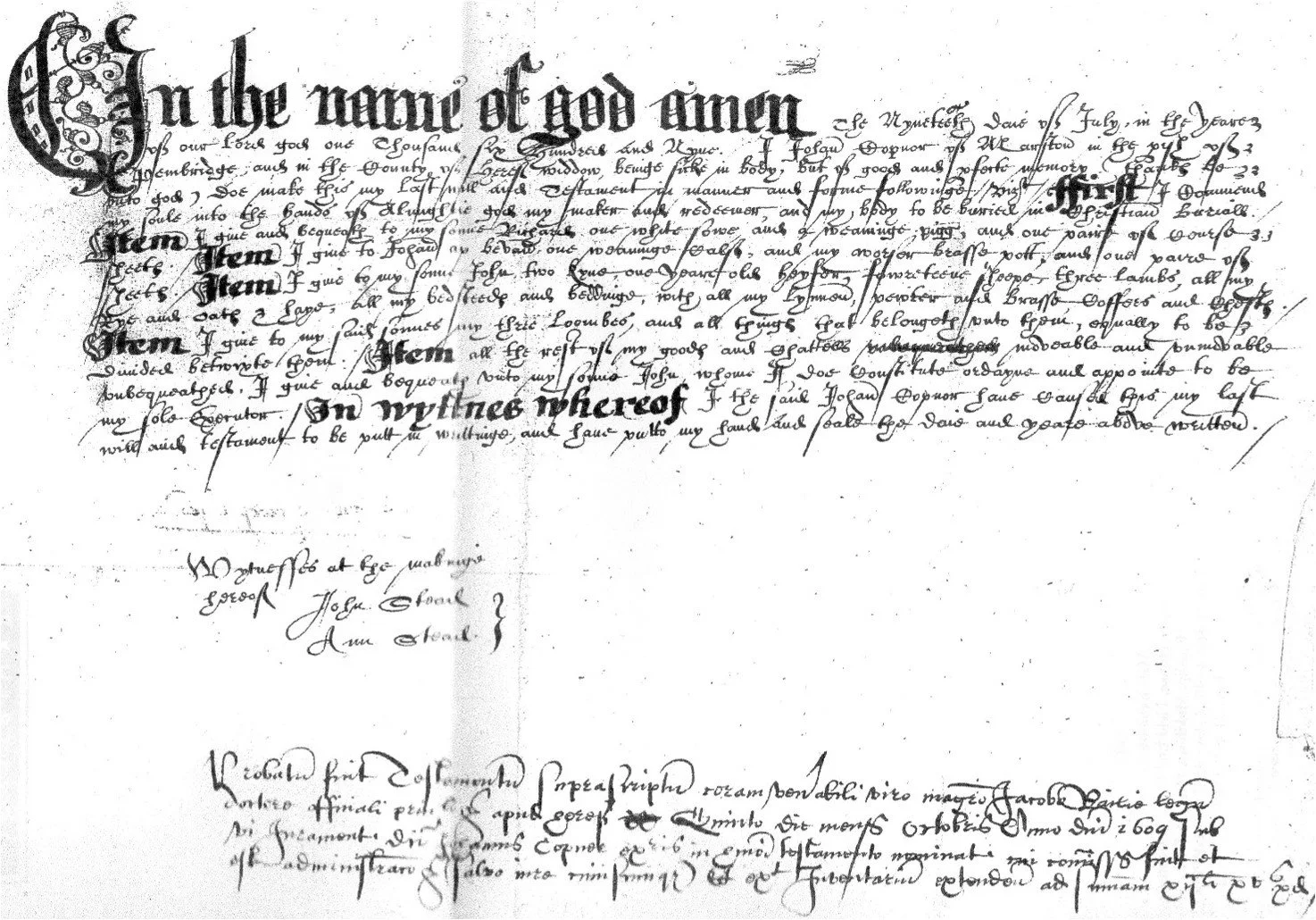
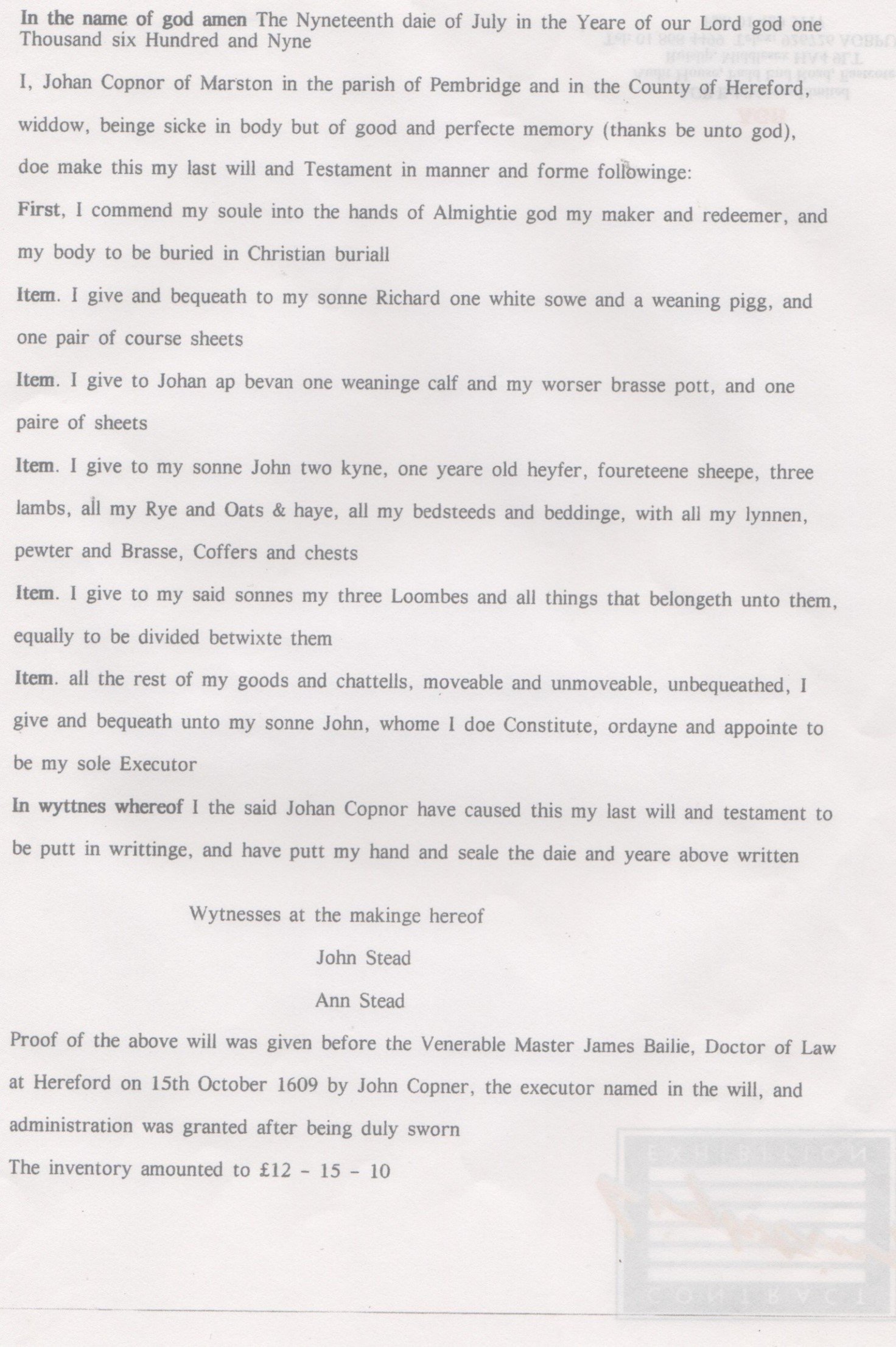
Joan died a month after her husband, Henry Copner.
Most of the estate goes to their second son, John. This is unusual as Richard, the older son, is still alive at Joan’s death.
Women’s lives at this time were under the control of their husbands or brothers, so Joan must have been well regarded and capable to be left in charge of the farm and weaving business when her husband died. The two sons, Richard and John, were in their thirties so there would have been a tradition for an older son to inherit.
It is estimated that only 15% of wills and inventories belonged to women.
This will tells us that the family are weavers as Joan leaves ‘loombes’. There is no mention in any of the family wills of spinning equipment, so it is assumed that yarn was brought in. Besides this family industry, they also manage a small mixed farm with ‘pigs, kyne (cattle) sheep, lambes plus rye, oats and haye’.
Weavers could be working on their own or have apprentices that lived with the family. The number of beds in the ‘chamber over the shoppe’, in a later will, would suggest this was the case.
The bequests are valued at £12.15s.10d.
What is happening locally:
This part of the country was known since medieval times for the fine quality of wool from Ryeland sheep. This wool was sought after in mainland Europe. It was called ‘Lemster Ore’ (Leominster Gold) as it brought wealth and prosperity to the local area. Cottage industries that were associated with the wool trade, such as weaving at home, grew up around the market towns. Both skills and equipment were passed down through generations to provide families with a steady income that supplemented the less profitable farming revenue.
Towards the end of the 17th century there was a period of massive expansion in building in the area of the Welsh Marches. This was known as ‘The Great Rebuilding’ and continued well into the 18th century.
The Hearth Tax reports that the family home at the time of this will had two ‘hearths’, which suggests that the house comprised four rooms (One hearth was equal to two rooms). This is evidenced in the footprint of the old part of the house today. One enters by a cross passage which takes one directly into the ‘hall’ or main living room. Behind this room is a smaller ‘parlour’ room by which one could access two ‘chambers’ by ladder. However, the ‘chambers’ were not only used for sleeping, but could store grain or the paraphernalia of the weaving industry. A large double fireplace is central to the building, serving all four rooms. This second room was possibly the site of the main weavers’ ‘shop’ as the roof jettied over a courtyard which fronted the lane through the hamlet.
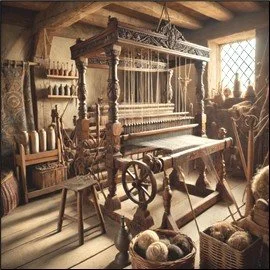
17th Century Weavers Loom
What is happening in the world:
James 1, the first Stuart king, was on the throne of England and Ireland. In Scotland he reigned as James V1.
Shakespeare was writing his sonnets.
Virginia in the United States was being colonised and Bermuda was “discovered.”
Tea was brought to Europe from China for the first time by Dutch traders.
The world was in the grip of ‘The Little Ice Age’ when winters were harsh and summers were short. Rivers would freeze over and food was scarce.
Will of Richard Copner 1614 (Age 36 years)
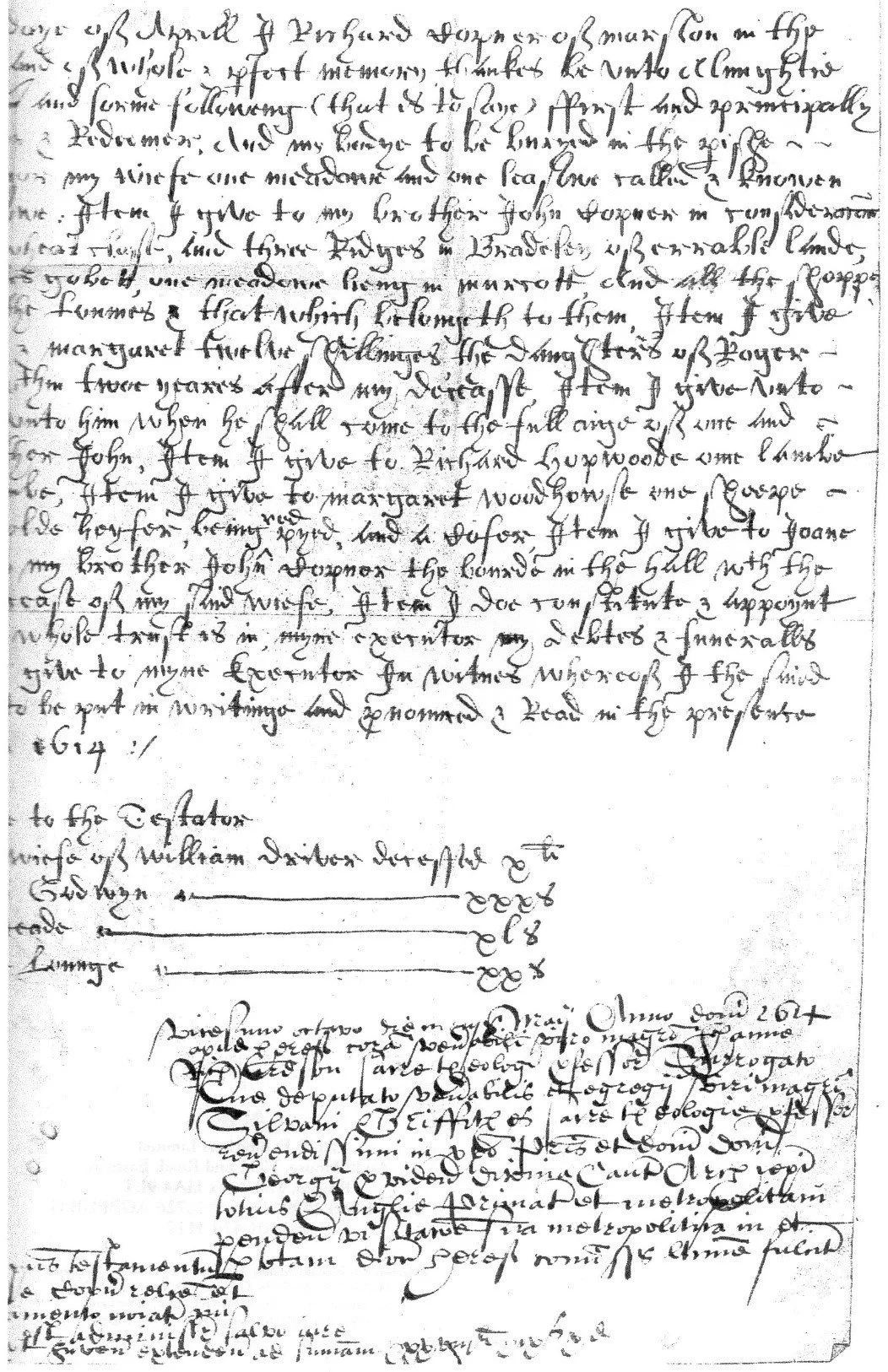
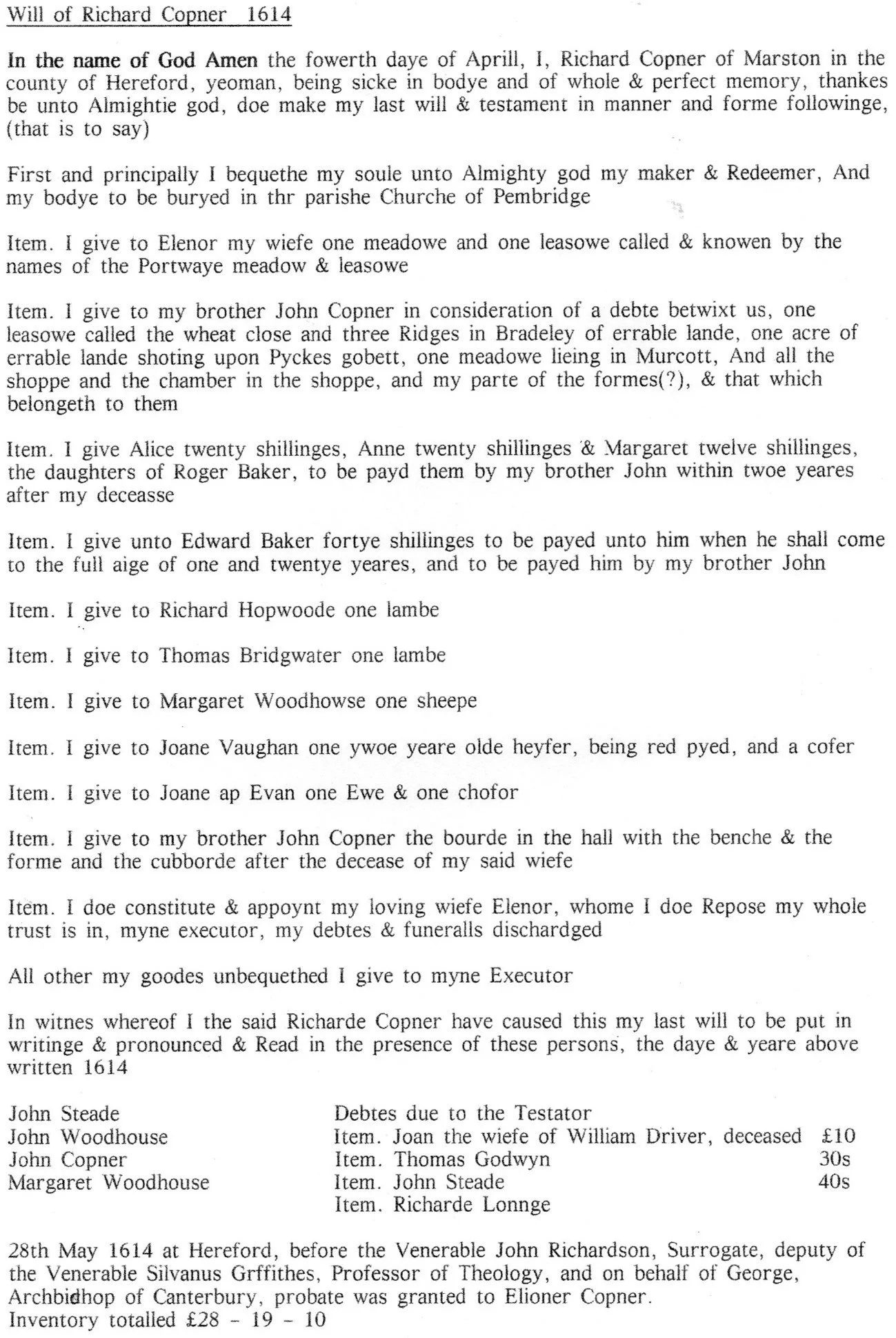
Richard Copner 1614 - Interpretation
Richard is described as a ‘yeoman’ which shows an increase in status from his parents.
More fields are bought by the family as the farm expands, although they are still weavers. Some of the land they are buying is dispersed five or six miles away.
Richard mentions ‘three ridges’ which describes the ridge and furrow system of farming that could still be seen at this time in rural Herefordshire. This was a relic from mediaeval management of an open field system where each family farmed their own furrows in a large common field.
The value of the assets has more than doubled in the last five years.
A ‘shop’ is now part of the house which indicates more substantial trade.
The will describes the house arrangement and some of the domestic ware: ‘shop and the chamber’, ‘formes’, ‘furniture’, ‘coffer’, ‘the borde in the hall’ with the ‘benche & the forme and the cubborde’. The ‘hall’ is the main living room, not a passageway as we know it.
The will is signed by his brother, John and the next-door neighbour, John Stead.

Image of a rural weaver’s cottage in the mid-17th century
What was happening in the UK:
The ‘Addled Parliament’ of King James 1st was governing the UK although it only lasted six weeks. James made himself very unpopular as he tried to raise taxes, but not one piece of legislation was passed.
Merchants were becoming wealthy as international trade routes were being established.
However, most people were living in terrible poverty in this county. Poor Laws were passed to help families in distress, but these families were large and people lived in very crowded conditions. Mortality rates were high. Women often gave birth to eight or ten children, but disease and malnutrition meant that usually only a few children survived.
What was happening in the world:
Pocahontas married John Rolfe in Virginia, United States. This brought peace to the unrest since Britain colonised the state.
Thousands of Jews were expelled from the ghetto in Frankfurt, Germany. Many found their way to the UK and set up successful businesses in English towns.
Admon of John Copner 1674
Inventory of ‘Goodes Cattells and Chattells’
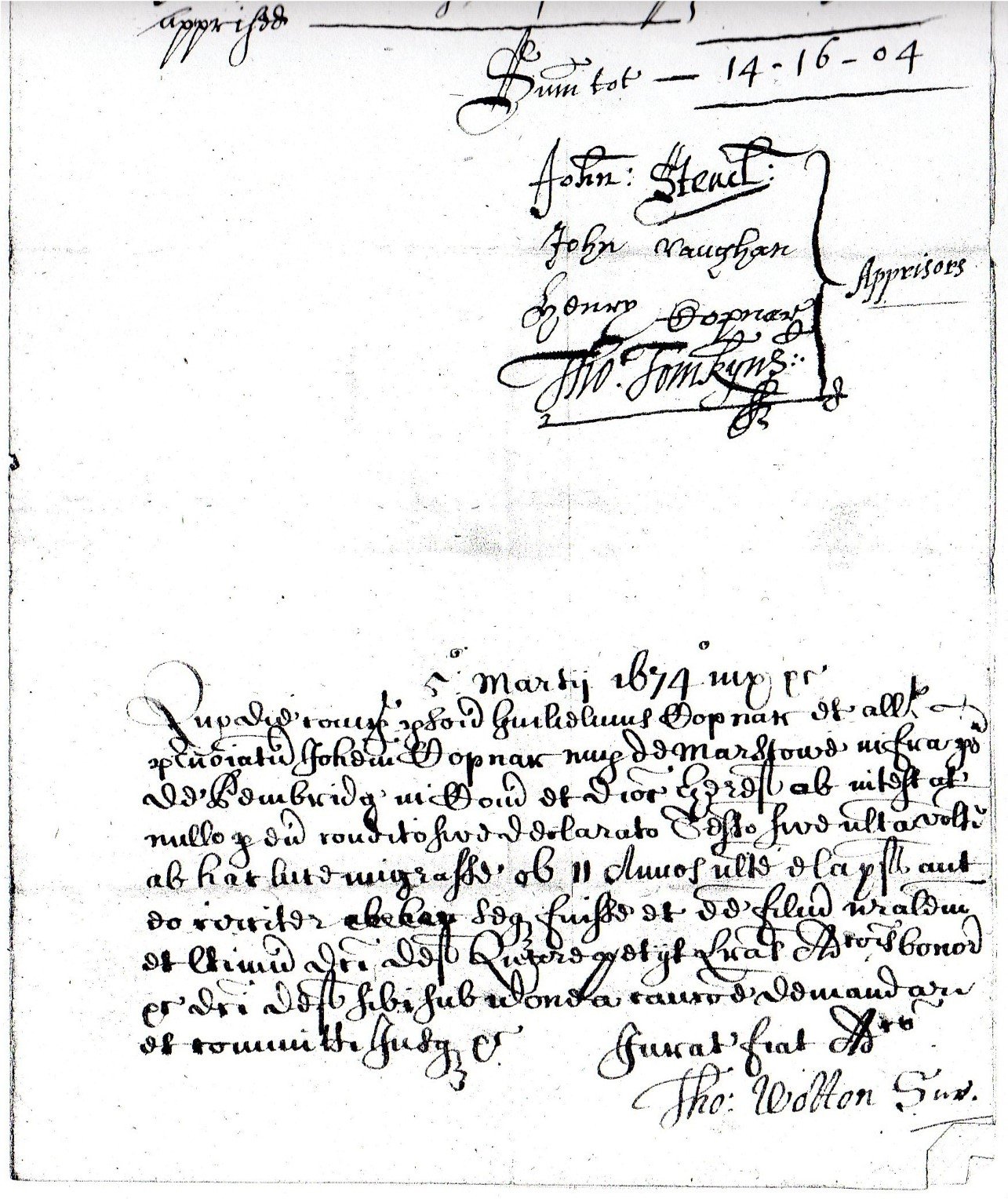
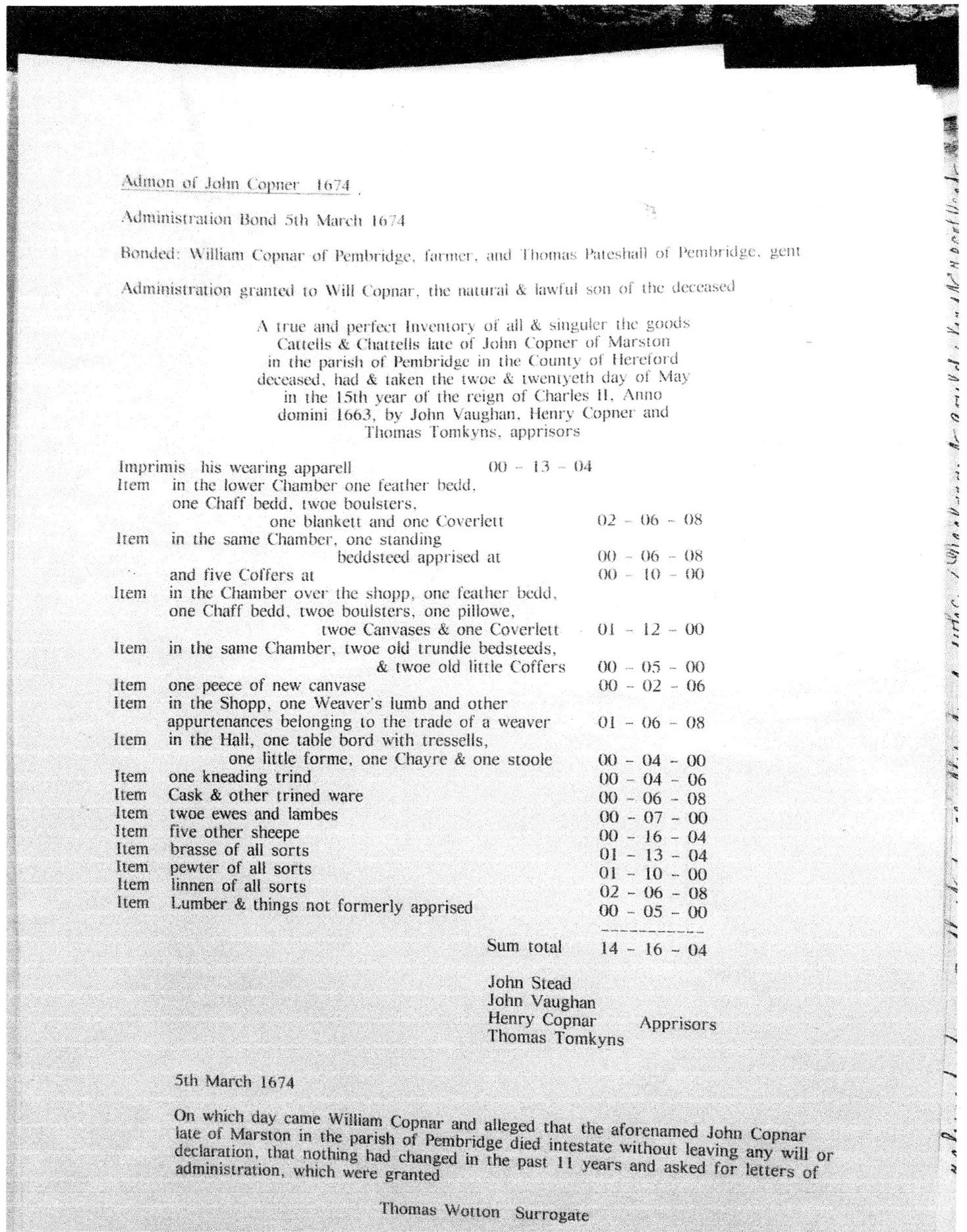
John died intestate in 1663, so the legacy had to be proved by his eldest son, William Copner. This involved travelling to Hereford with evidence of kinship. At this time, it would cost five shillings to make a will, so an inventory was often drawn up by neighbours if there were no surviving relatives. Value of the goods listed was based on the second-hand prices that might be paid at market. The inventory was not a true reflection of a person’s wealth as ready money, property and land ownership are not mentioned. John’s “wearing apparel” was important enough to be included.
We learn from the inventory about the sleeping arrangements in the house: seven beds in two rooms. There were three beds in one downstairs room and four beds upstairs ‘over the shopp’. These beds ranged from trundle beds (pull out beds resembling cots) a “Chaff bed” that was made of a straw mattress, feather beds and a standing bedstead which was presumably for the Master and Mistress. People were used to sharing both beds and bedrooms.
The weaver’s shop was still part of the farmhouse although the family were still farming. However, the emphasis from this inventory reflects the arrangement of a weaver’s shop rather than the farm.
The ‘hall’ contained the domestic furniture, table, bench, chair and stool. This is not a hall in the modern sense of a passageway but was a main living room or even open plan kitchen/ living area.
A ‘trind’ is a small wooden bowl used for kneading bread dough.
A ‘coffer’ is a small chest used to store papers or fine linen.
Lumber is important enough to be listed as it was used for maintenance of buildings as well as for firewood. Lumber also meant general wooden items of furniture.
Evidence from other documents show the family were consolidating ownership of farmland at this time. Previously fields had been dispersed, some as far as five or six miles away, but during the latter half of the century they acquired more land adjacent to the main house.
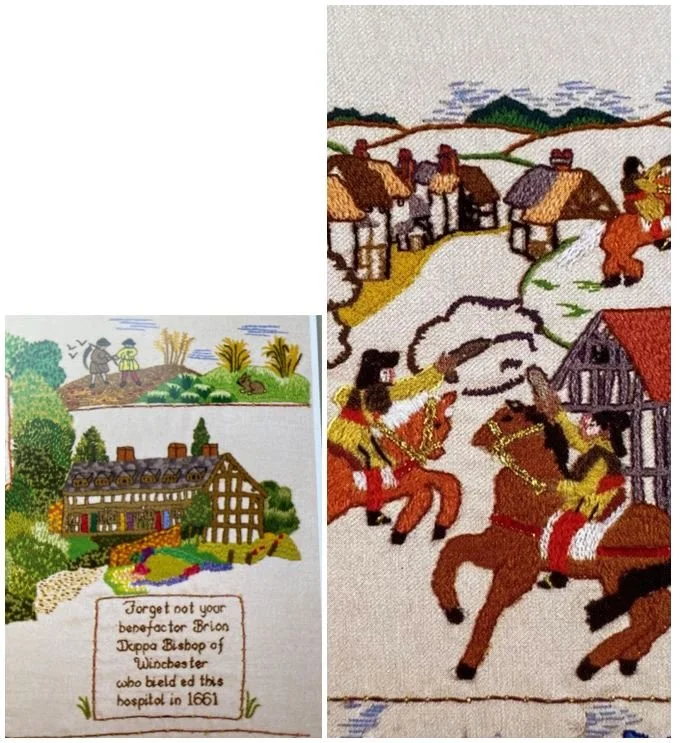
Details from the Pembridge Tapestries, left The Duppa Alms-houses, constructed in 1661 while John and William were living in Marston. Right the English Civil War of the 1640s was fought while the Earl of Essex, Robert Devereux, owned the Manor of Pembridge. The Pembridge Tapestries are on display in St Mary’s Church and tell 1,000 years of the village history from Doomsday to the present.
What was happening in the UK.
John had lived through the Civil War.
Charles 11 was on the throne.
The first English newspaper was printed in 1641, and the first women’s magazine was The Ladies Mercury in 1683.
The Treaty of Westminster ended the Anglo Dutch War and gave the town called New Netherland to Britain. This became New York.
The years of the late 17th century following the Restoration of the monarch saw a depression in agriculture, with landowners finding it difficult to find tenants.
What was happening in the world.
The Torsaker Witch Trials began in Sweden. 71 women were beheaded and burned. Belief in witchcraft was prevalent at all levels of society across Europe, even among highly educated people.
In some houses people marked a beam or a post with protection symbols such as daisy wheels or a consecration cross. Similarly, deliberate scorch marks were made, to protect the house against fire.
Will of William Copner, 1712 (Age 76 years)
William was unmarried so his assets passed to his nephews and nieces.
His will describes him as ‘yeoman’, which suggests a higher status than his father (John Copner) although William could not sign his name to his will, either because he was illiterate or physically disabled. He only made a cross.
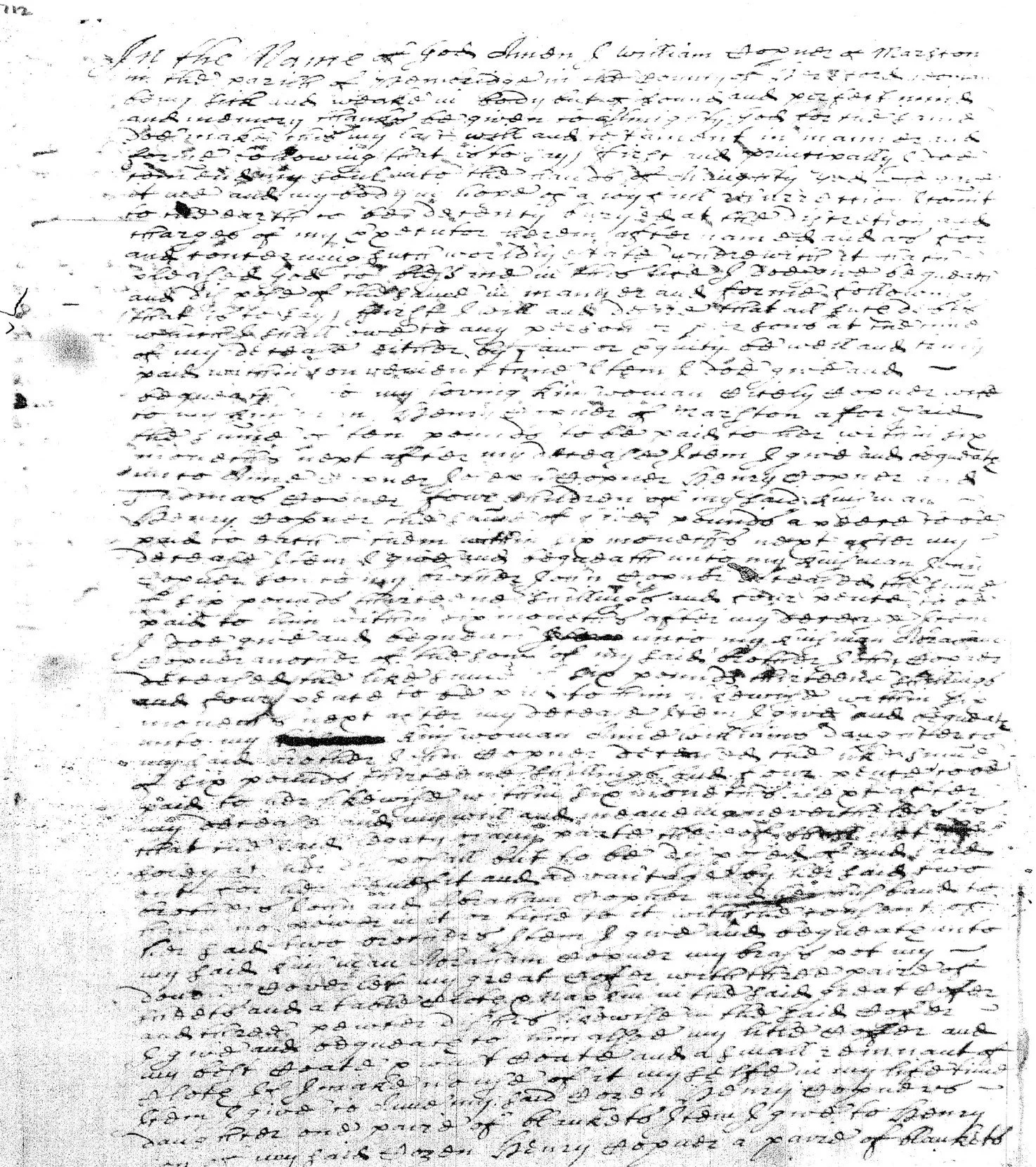
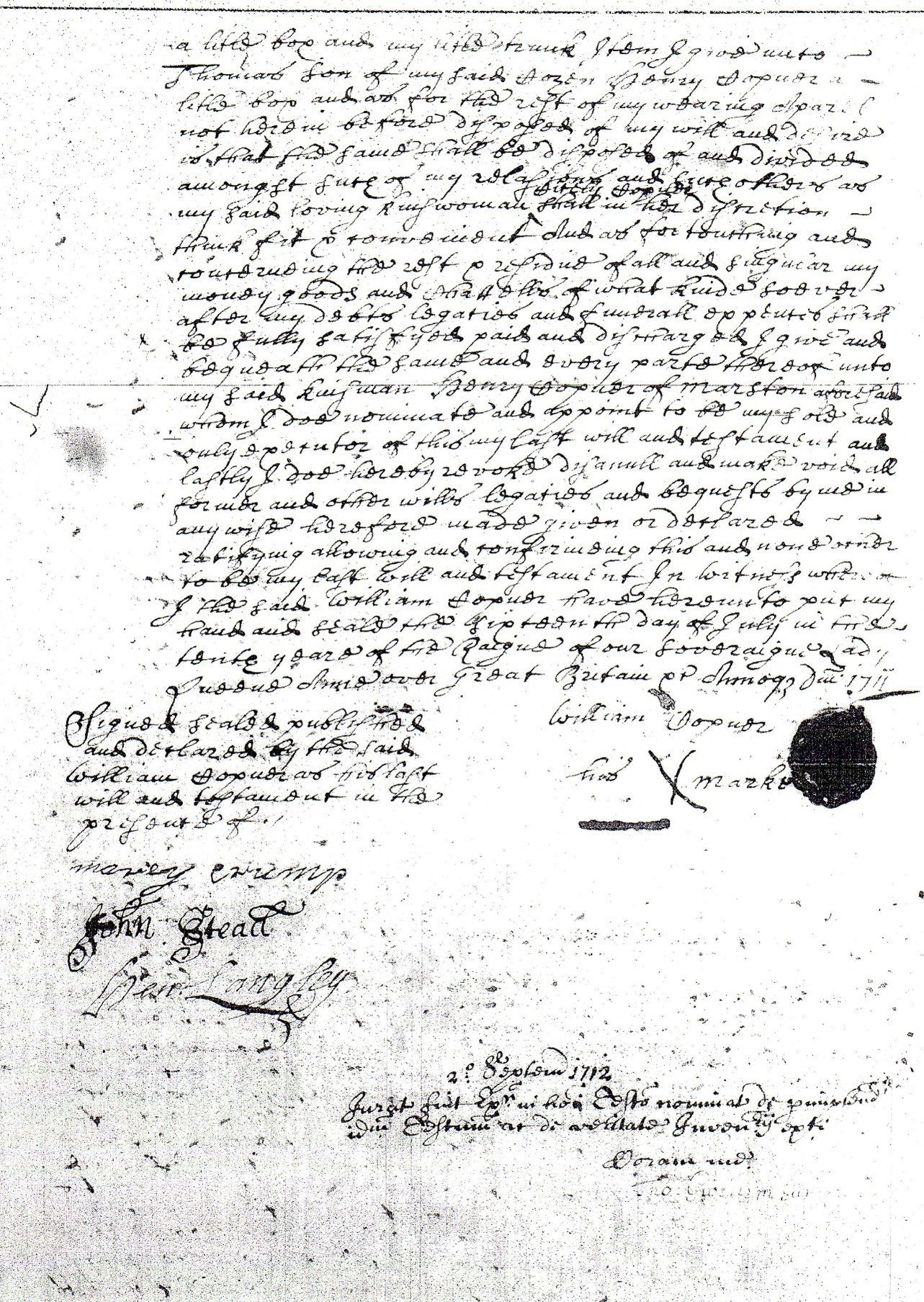
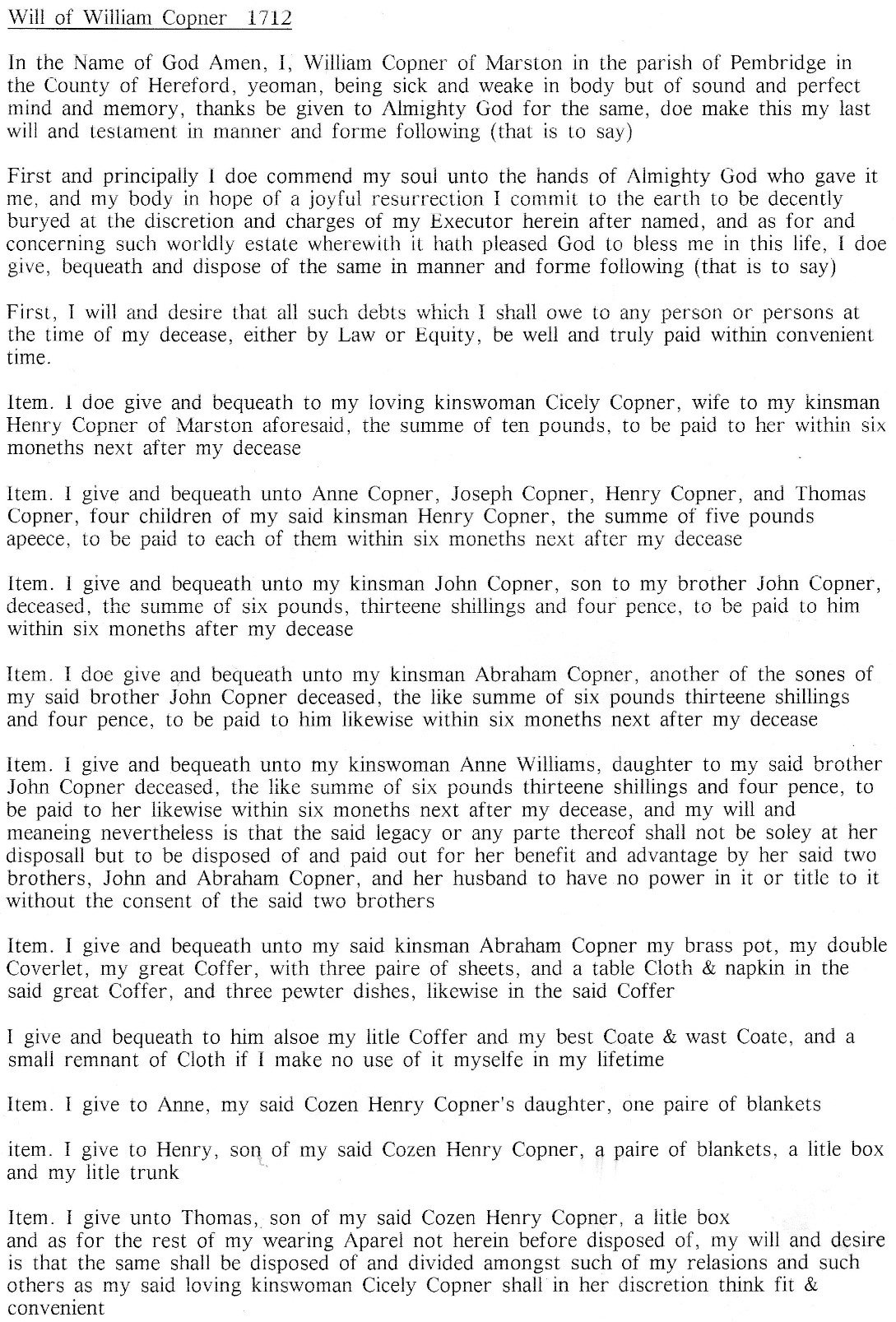
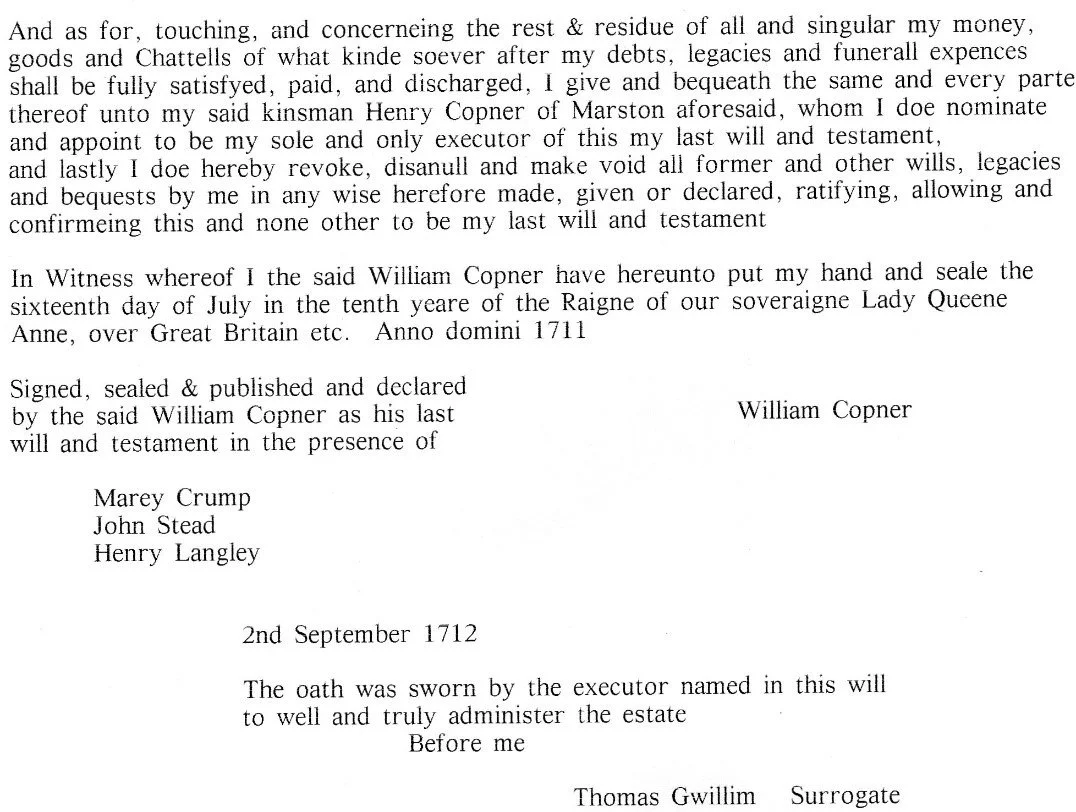
For his nephew Henry’s family, £10 was left to Henry’s wife Cecily. £5 went to each of Henry’s children, Joseph who was fifteen years old at the time, Anne, Henry who was eleven and Thomas who was just eight years old.
To William’s second nephew John’s family £6 13s 4d went to John’s son also called John who was a weaver and thirty-six years old at the time. Presumably this John lived in the weavers’ house in Marston. John’s second son Abraham who was thirty-five years old also received this legacy.
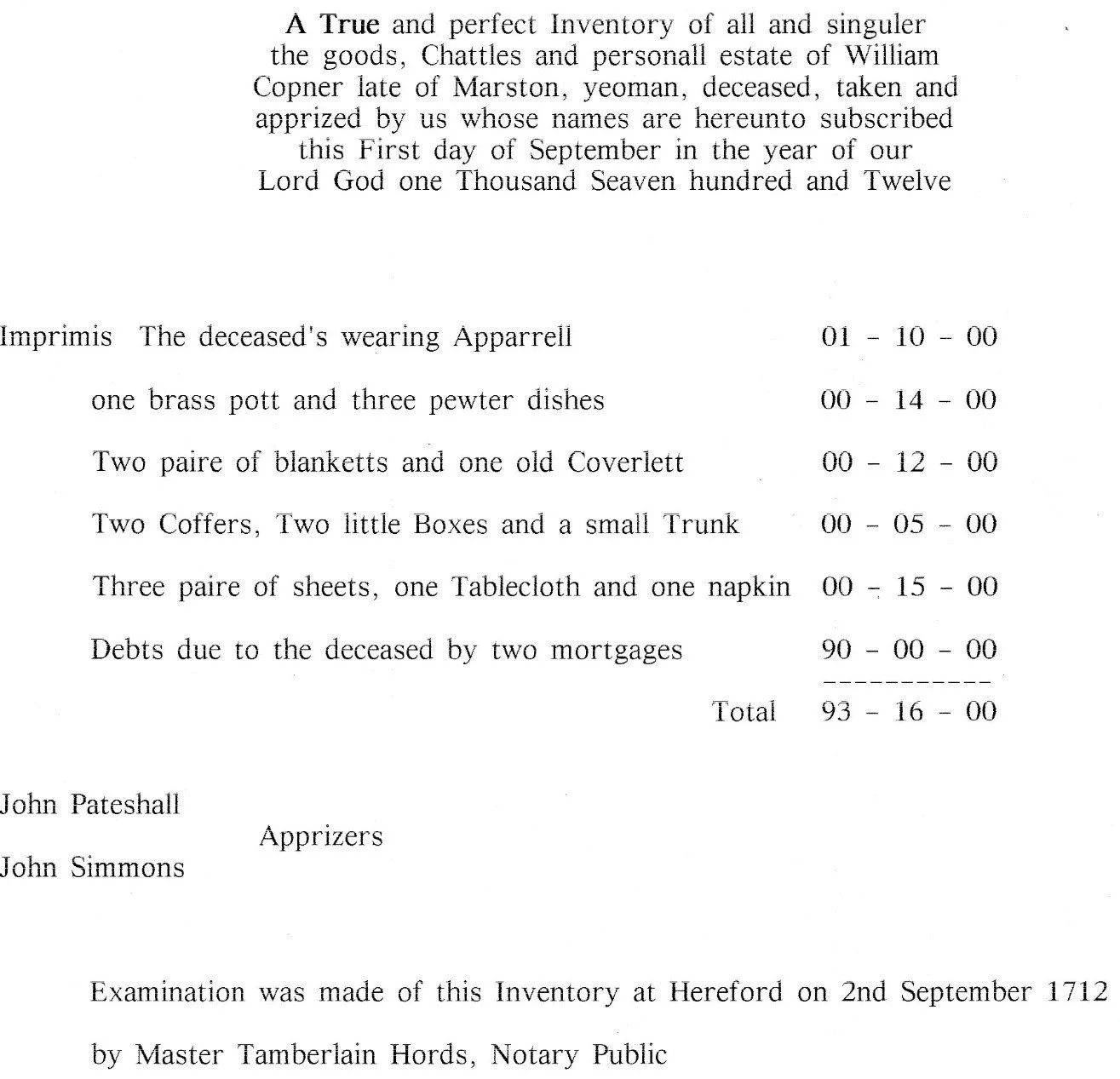
Abraham (William’s grandnephew) is bequeathed the brass pot as well as most of the household ware. He also has some clothing. The ‘brass pott’ is also still important enough to be mentioned and the ‘three pewter dishes’ show a degree of status and a definite improvement from the wooden dishes that were more commonly used at this time.
£6 13s 4d was bequeathed to his niece Anne ‘and for her husband to have no power in it’. which must have afforded her some independence as at that time a wife’s property was usually owned by her husband until the Married Woman’s Property Act 1870. However, it does sound as though William was looking to control her interests from beyond the grave.
Bed linen and chests go to his cousin’s children, and the rest of the clothes are distributed amongst the other ‘relasions’. This again tells us that clothing (the wearing apparel) is more valuable than kitchen ware and wooden chests. Bedding is treasured and handed down through generations. One wonders how often it was changed and washed, especially during the winter months.
William’s nephew Henry inherits the “rest and residue” money as well as the ‘goods and Chatells’. Henry also becomes the Executor of his uncle’s will.
Debts from two mortgages that are owed to William describe the increased wealth for the family as they obviously own more than one property.
What was happening in the UK:
Men wore breeches at this time, with stockings and boots. Their shirts were usually linen. They often still had their hair long and wore beards. Wealthier women wore corsets to emphasize a small waist, whilst working women had loose fitting long gowns reaching to the ankle and made of wool, linen or homespun cotton. Clothes for both men and women were of dark colours as dyes were expensive.
Women wore aprons to protect their gowns when in the house. Underneath there was a long-sleeved shift that doubled up as a nightgown, neither men nor women wore underwear as we know it. Women also wore several petticoats which were numbered according to the weather and season. Both men and women wore head coverings, wool cloaks, and capes. Clothing for farming families would be simple, sturdy and easy to repair.
At the end of the 17th century, it is estimated that the population of England and Wales was about 5 ½ million and the population of Scotland about 1 million. However, in the 18th century the population grew rapidly so by the end of that century it was well over 9 million.
It was also a time of significant economic expansion with the beginnings of new ideas heralding the Industrial Revolution.
George I was King of Great Britain.
There had been a change from arable to pastoral farming during the last few decades in Herefordshire, especially in sheep rearing which is recognised now as being under recorded. Ryeland sheep were popular because of their hardiness in the cold, often wet climate of the Welsh border.
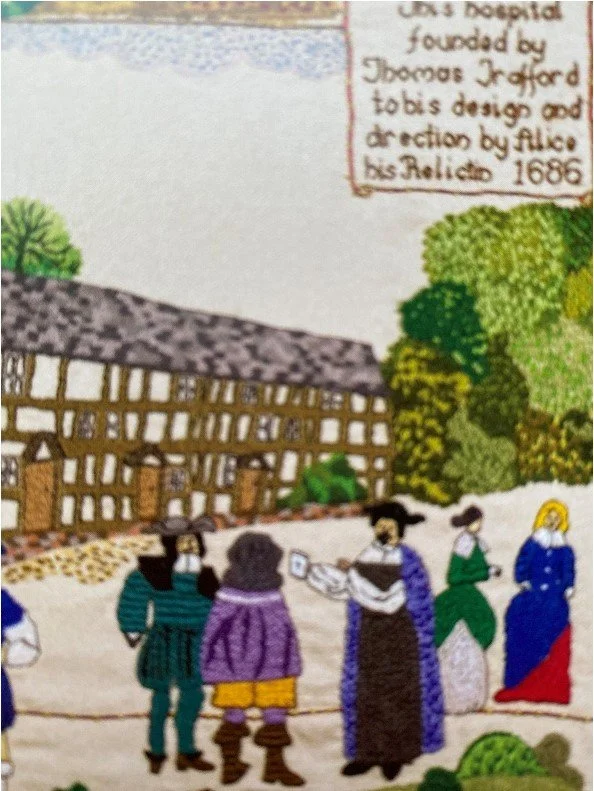
Detail of Trafford Alms-houses opened in 1686.
Pembridge Tapestries
What was happening in the world:
The slave trade was underway which fuelled the expansion of colonial wealth around the world. In this year of 1712 a group of Negro slaves tried to rebel in New York against their cruel treatment, but this was put down with brutal executions.
Sweden was fighting a losing battle against Russia which shaped dynamics in northern Europe.
Will of Henry Copner 1729 (Age 51 yrs)
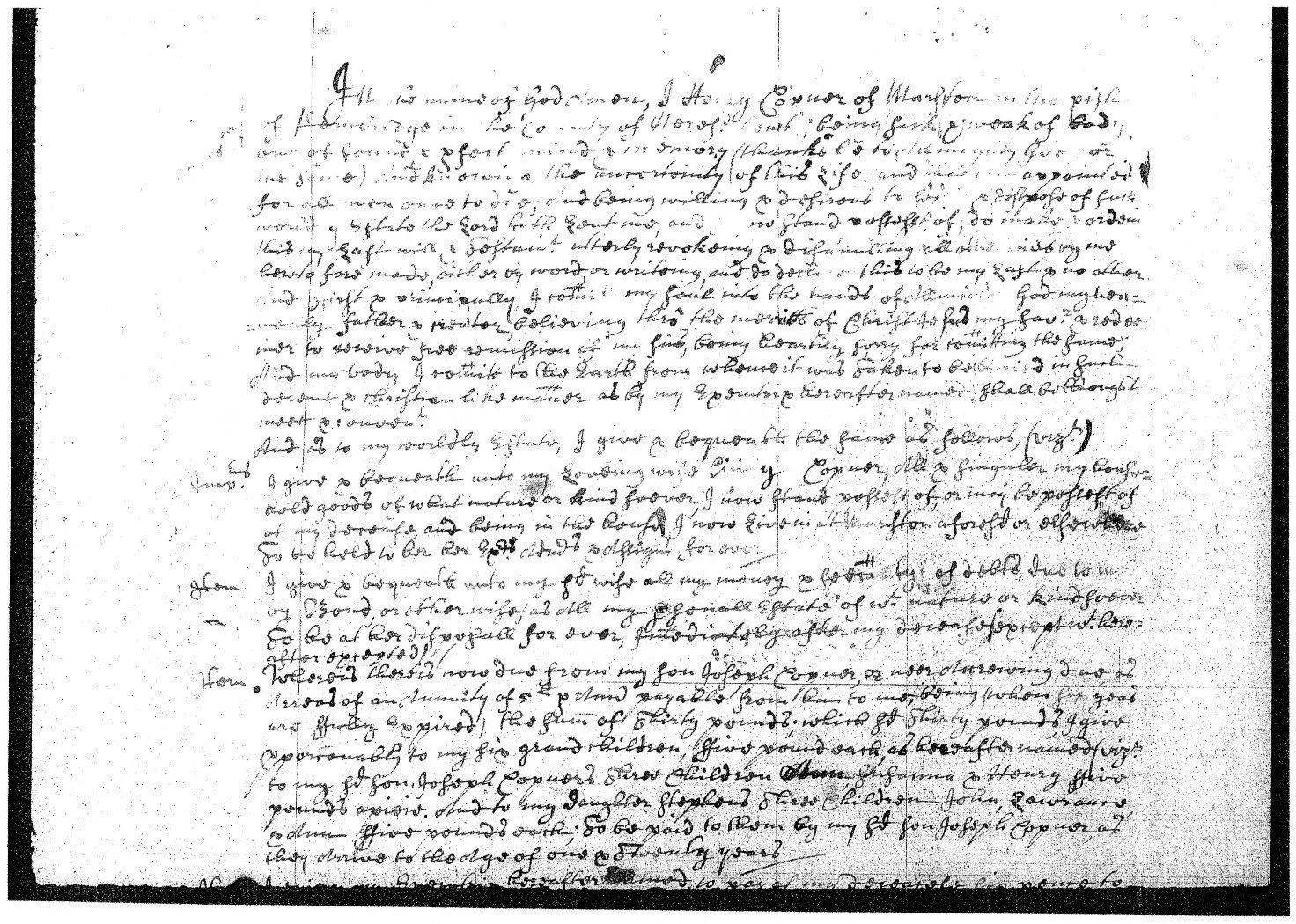
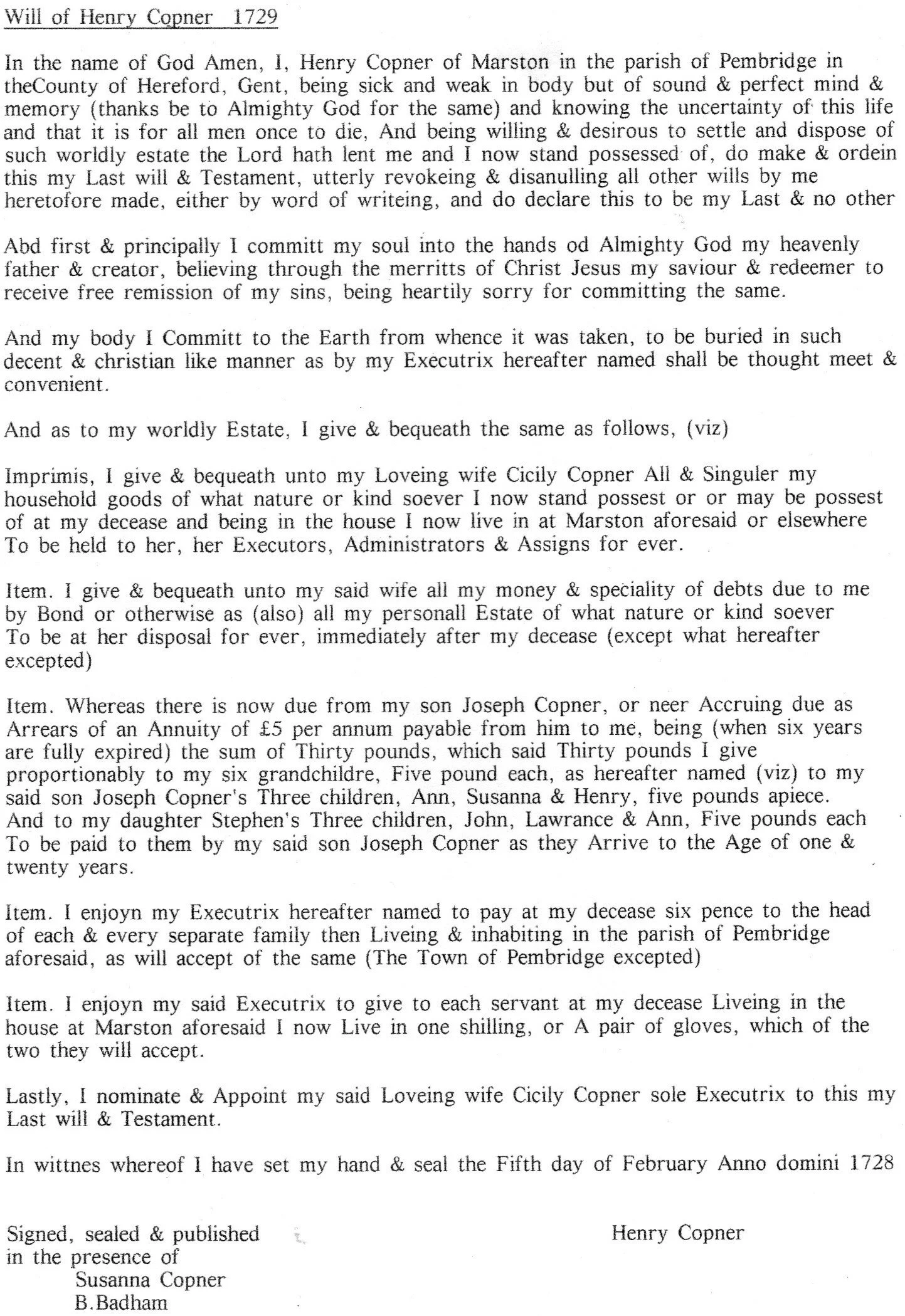
Henry is living at Marston, probably in the farmhouse where he grew up.
He tells us that “it is for all men once to die” and sounds a religious man who is worried about his soul as one third of his Will is made up of spiritual references.
All his worldly goods are passed to his wife Cicely, (also spelt Sisley) apart from the money (£30) that was owed to him by his oldest son Joseph. This sum is to be paid at Henry’s death by Joseph to his own children as well as the children of Joseph’s sister Anne.
Why has Henry bypassed his elder son, Joseph? Was there disharmony between them?
Henry’s second son, also called Henry is noted to be “of London” at the time of this Will. Henry’s youngest and third son, called Thomas, had died at the age of eight years in 1711.
Henry pays 6d to everyone in the Parish of Pembridge but does not include the “town” of Pembridge. It is a great deal of money to be handed out but raises the question of his reluctance to share it with people from the town.
His servants are also rewarded with a pair of gloves, or the 1 shilling that they would have cost at the time.
Henry is described as a “gent” which indicates a higher status than his parents who were simple ‘yeomen’. At this time there was an increase in the number of ‘new’ gentry who invested in land or property then leased it out. Being a “gent” meant a more cultured lifestyle with education and literacy, some smart clothes and a more spacious home.
Henry was able to sign his name to the will.
What was happening at the time:
Following the success of the wool trade and the tradition of cottage industries, glove making played a large part in the local economic activity during the 18th century. The museum in Leominster owns some pairs of gloves made locally at the time.
Gloves were made of leather which came from sheep and lambs’ skins. These were hand stitched and decorated according to cost. Families worked from home and women or children contributed to the making of gloves.
Trade routes and fairs in the Welsh Marches helped in the marketing of this industry. Towards the end of the 18th century the development of mechanisation with the Industrial Revolution threatened this traditional craftsmanship.
In England there was opportunity for social mobility although there was a depression in the 1730s and 1740s because of food shortages which led to high levels of mortality.
George II was King of Great Britain and Ireland.
What was happening in the world:
The Treaty of Seville brought the end of Britain’s conflict with Spain. This supported Britain’s claim to trade with America.
J.S. Bach was composing his Cantatas and St Mathews Passion.
People were questioning the traditional religious teaching as Philosophy and Science became popular.
Will and Inventory of Sisley Copner 1745
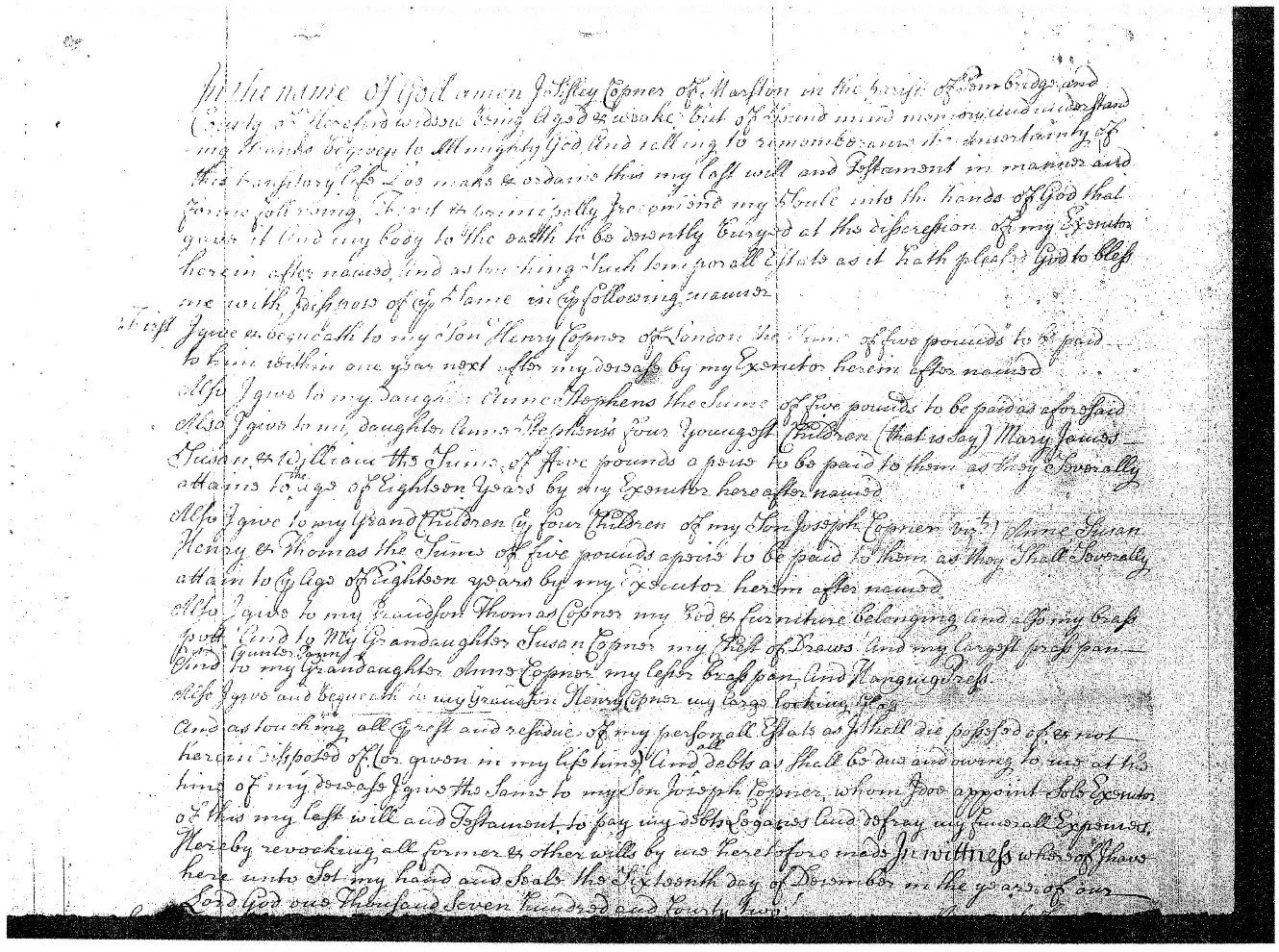
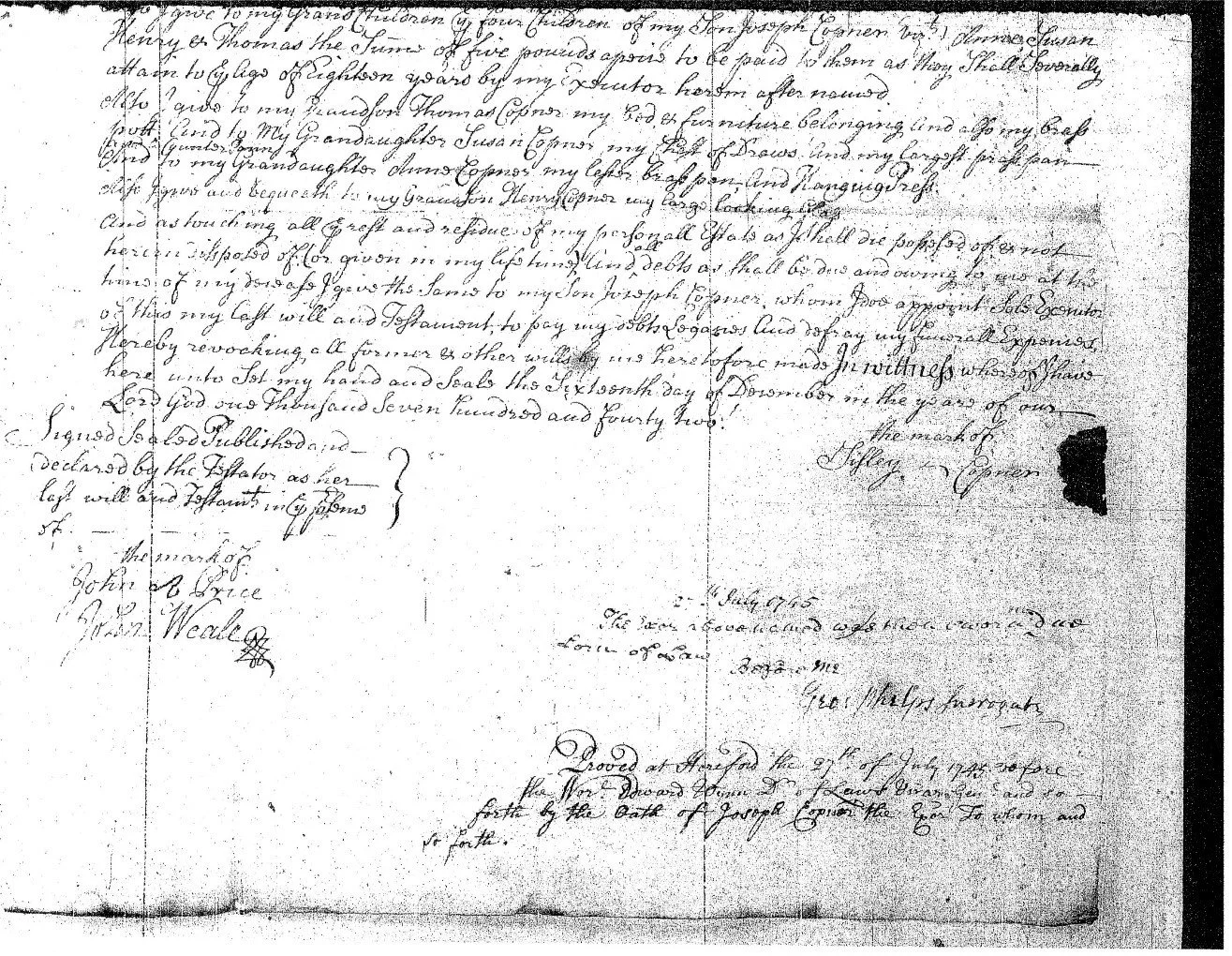
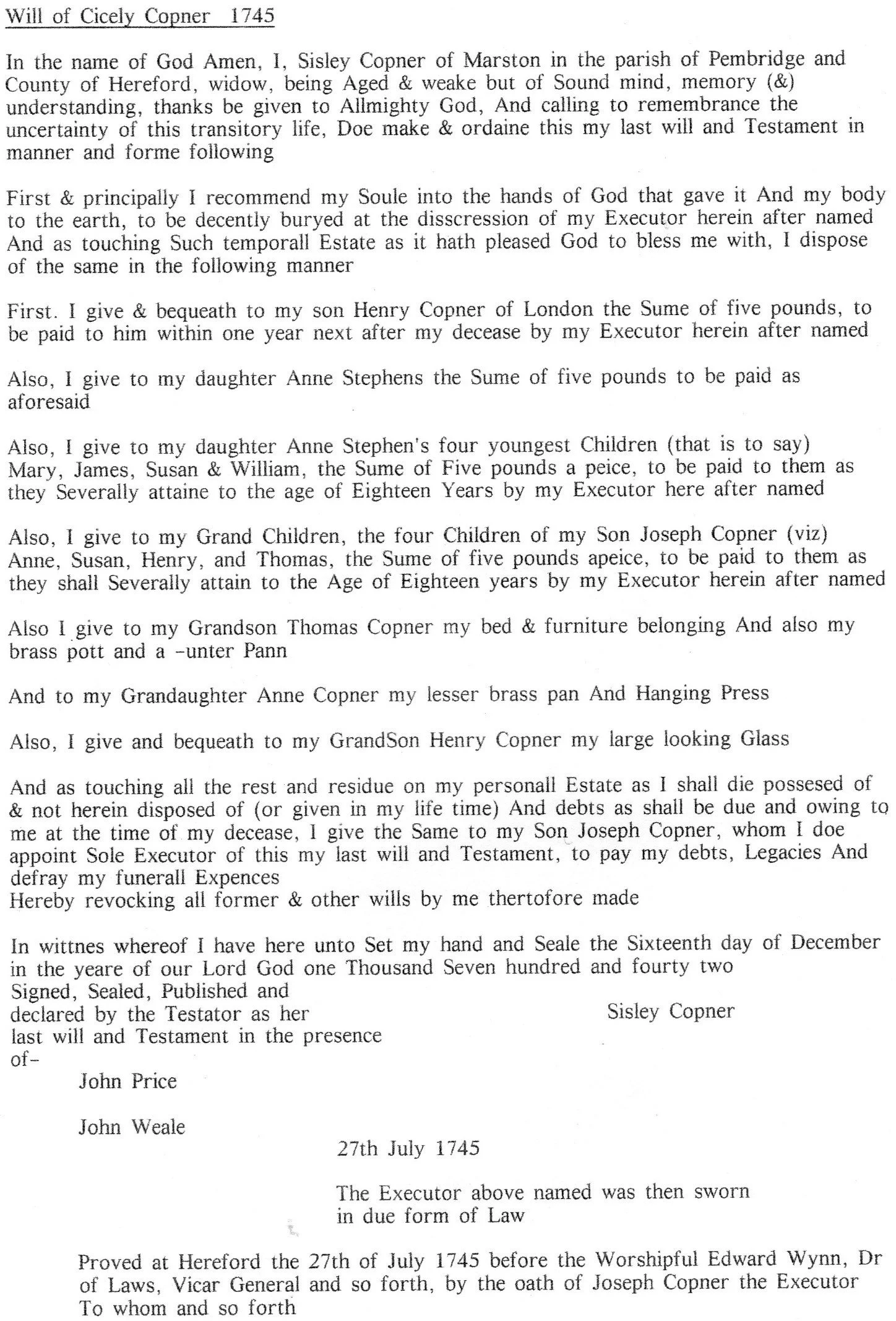
Sisley had been widowed for fifteen years when she died. She had three sons, Thomas the youngest had died in childhood, and Henry the middle son, was “of London.” It is possible that there had been an estrangement of this son as Cicely leaves only £5 to him.
Sisley’s daughter Anne and Anne’s four children each receive £5. Her eldest son Joseph children also receive £5.
At this time an agricultural labourer would typically earn between £18 and £30 a year so £5 was equivalent to 2 to 3 months wages.
Her grandson Henry is bequeathed the ‘brass pott’ as well as the bed and trappings. Henry also receives an ‘unter Pann’ which is a flat cooking vessel that was used like a modern bain marie. It is interesting to note the influence of the Dutch language filtering into rural English family life.
Sisley was unable to sign her name to the will, so made a mark. At the beginning of the 17th century only 14% of women were literate, although more than half the male population had some sort of formal education. Women were often schooled by their mothers at home whereas it was generally accepted that most yeomen could read and write.
Anne, the granddaughter of Sisley is left the ‘lesser brass pan’ and a ‘hanging press’ which at this time was used as a wardrobe for hanging clothes. The ‘large looking glass’ which is left to Sisily’s grandson Henry, shows that the family were enjoying a comfortable standard of living. A small ‘looking glass’ was valued at 6d in 1776. This level of comfort reflects a relatively peaceful time of history.
Inventory…
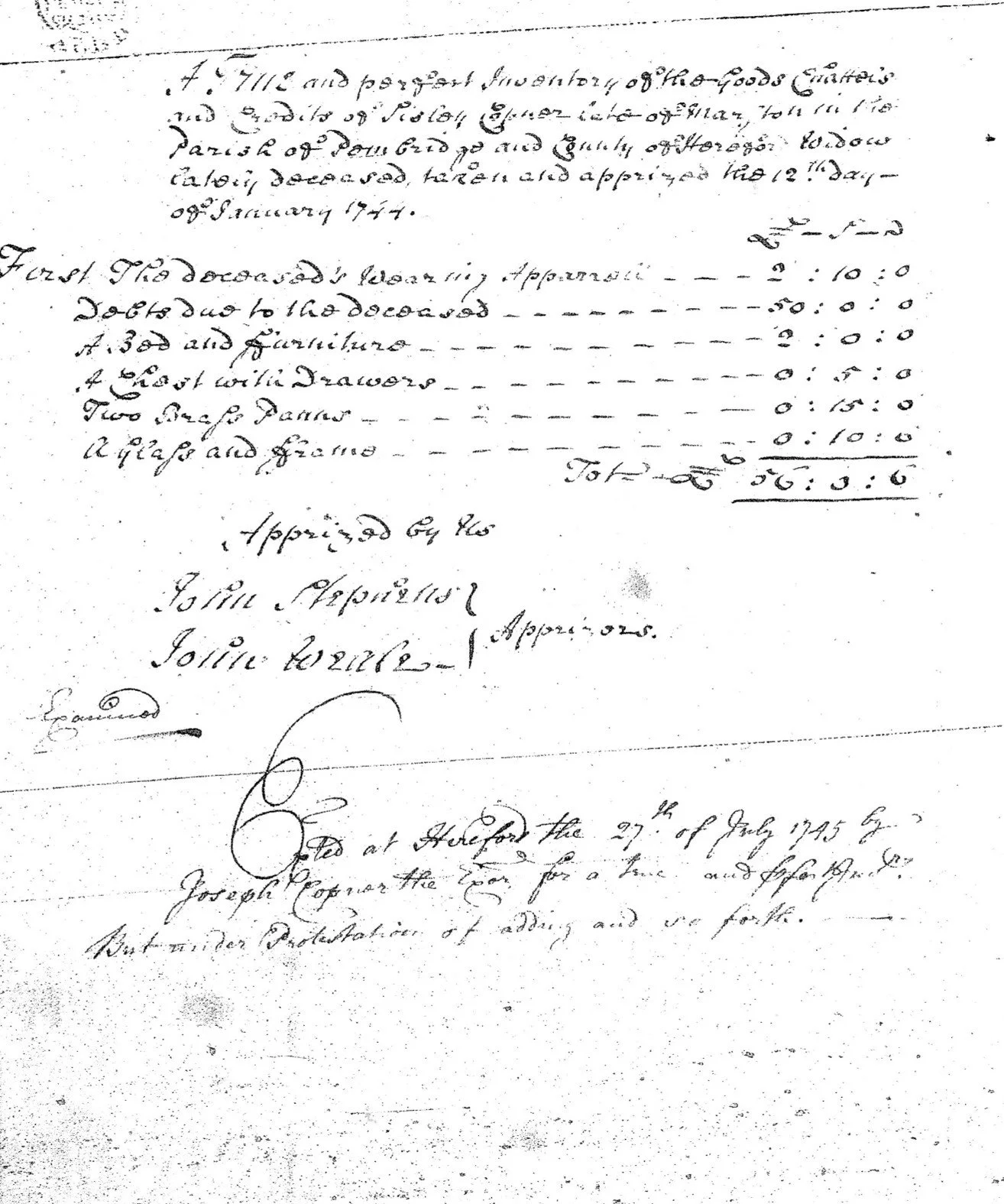
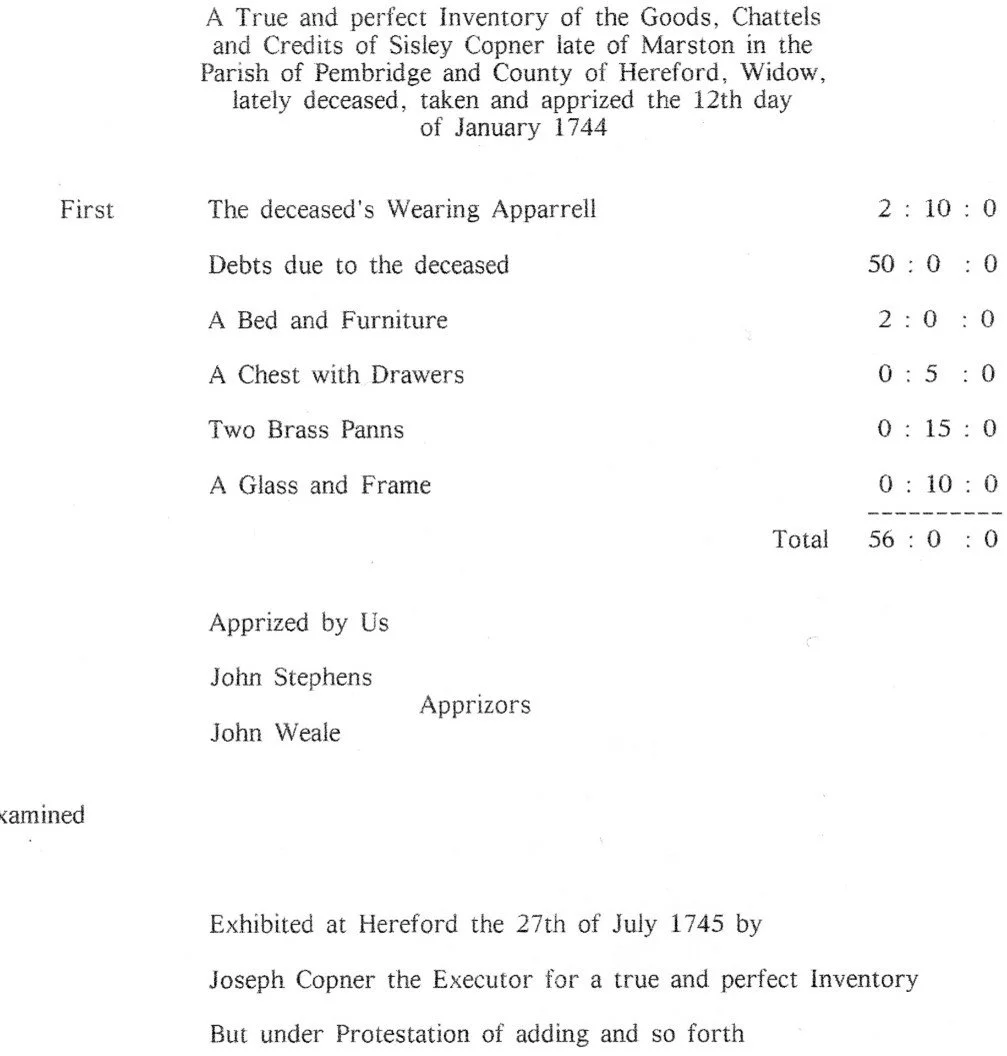
Sisley has debts of £50 owed to her, which was a large amount of money at that time, suggesting that she had substantial capital wealth.
Her ‘Wearing Apparrell’ is the most valued item, as it has been in previous Wills. Clothes have more value than Sisley’s furniture in this case, although the ‘Two Brass Panns’ are still significant possessions, important enough to be itemised in her Will.
What was happening in the UK:
George II was King of England, but Bonnie Prince Charlie had already started the Jacobite Rising in which he hoped to restore his father James Stuart to the throne of England.
Robert Walpole became the first Prime Minister of Great Britain.
There was a great rise in technology and productivity at this time. The open field system of agriculture with smallholdings owned by peasant farmers was being replaced by larger family farms that could afford up to date equipment.
The labourers’ diet was improving so people were living longer and were more productive during their working life.
What was happening world-wide:
This period of history is called ‘The Age of Enlightenment’ that showed advanced interest in science, philosophy and the arts across Europe.
The Royal Society of Arts was founded in this year.
Trade with China and India brought new spices and foods to Britain.
Handel premiered his oratorio Belshazzar in London.
Will of Joseph Copner 1767 (Age 71 years)
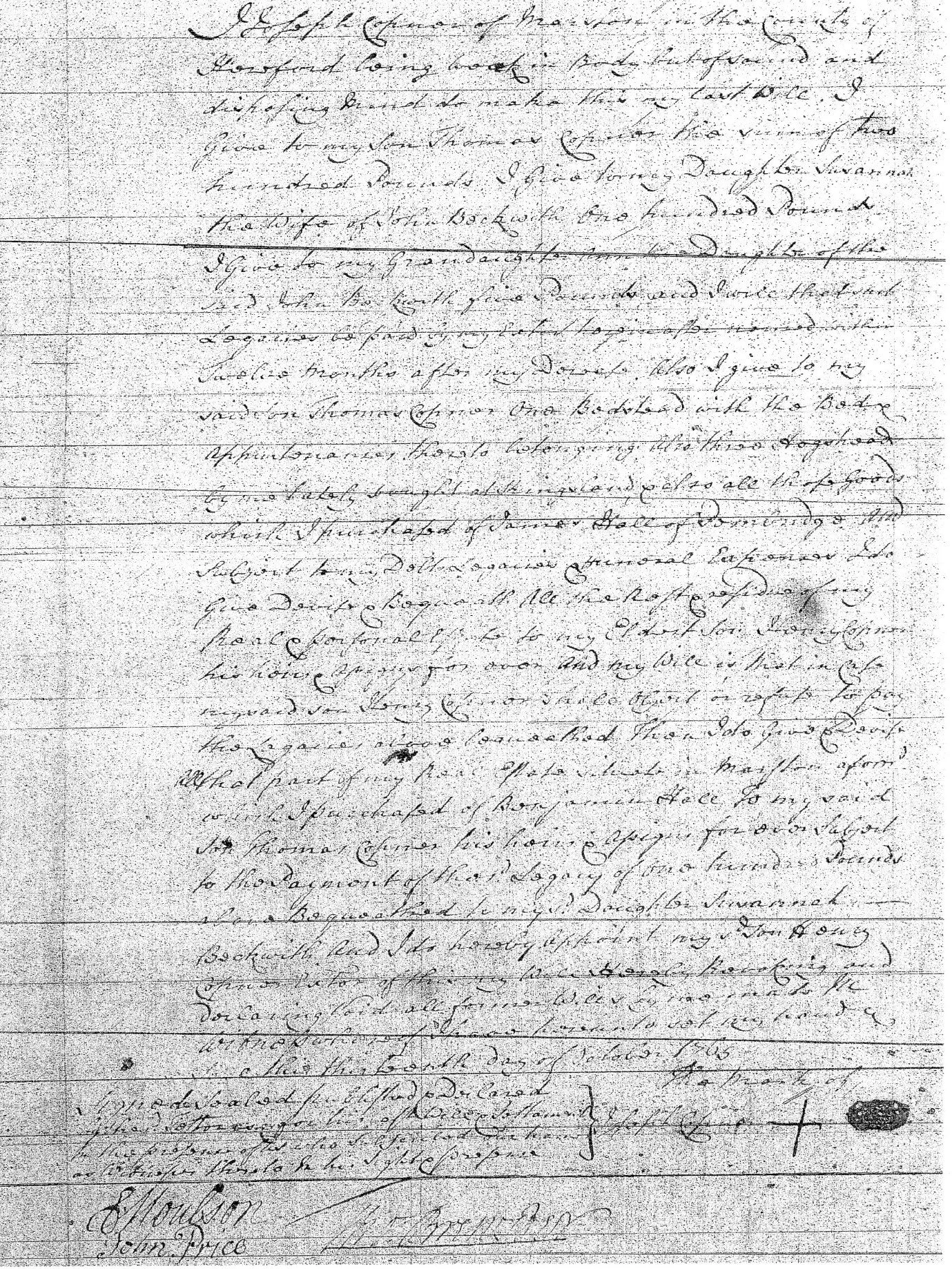
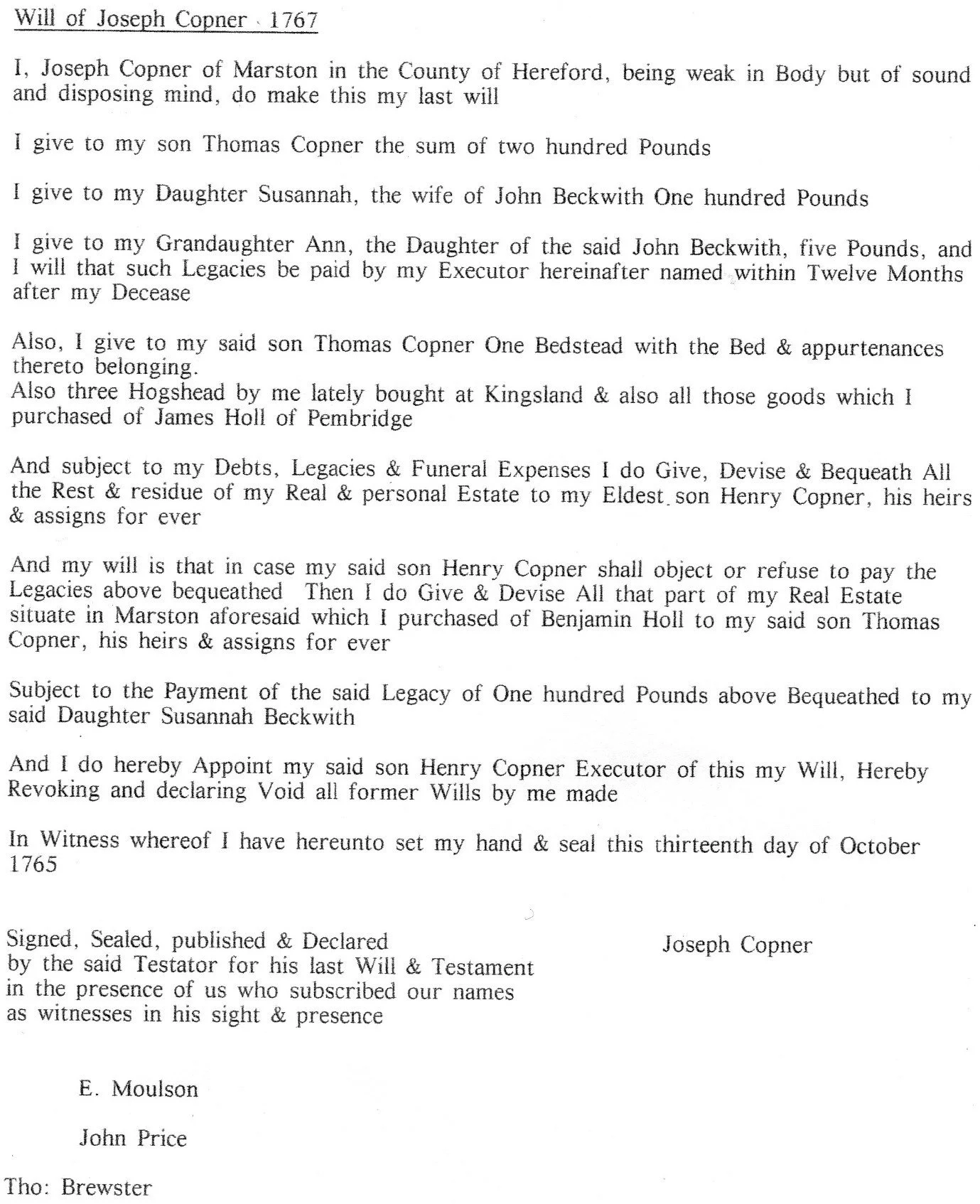
Joseph was the son of Henry and Sisley Copner. During this period the cottage industries of Pembridge, and the wool trade upon which the wealth of the area was based, were coming under increasing competition from industrialisation and cotton as the textile of choice.
Joseph’s Will is shorter than previous ones, and there are fewer religious references to the introduction.
Anne, the eldest daughter had probably already died as she is not mentioned in this will, although she had married in 1743.
Although Susannah is next in line with Joseph’s children, she only receives half the legacy of her younger brother Thomas’s £200.
Thomas also inherits the “Bed & Appurtenances” as well as three “Hogsheads”. A hogshead is a large wooden barrel to store wine, beer or cider. One hogshead would contain 238.7 litres of alcohol.
Most of Joseph’s legacy goes to his elder son Henry, who is 40yrs old at the time. However, if Henry refuses to pay his siblings what it due to them, then Thomas, the younger brother will inherit another property that Joseph owned in the hamlet. This could suggest that Joseph had concerns about the honesty of his eldest son, Henry.
The mention of another property in the hamlet suggests that the farm had prospered. A later 19th century sale document describes the farm owning seven other houses in the local area and farmland in three other parishes.
Acquiring land and property ownership increased the wealth and status of the Copner family. Presumably regular rents were coming in, and the farm could invest in expansion. Joseph’s father Henry had risen from a “yeoman” to a “gent” during his lifetime.
What else was going on in the UK ?
George 111 was King of England. He had fifteen children. Known as “Farmer George” due to his keen interest in farming.
The Spinning Jenny was invented by James Hargreaves which led to further industrialisation of the cloth industry.
Migration increased from rural areas of the UK to cities like Birmingham, Manchester and London as people sought well paid work in factories.
Josiah Wedgwood set up his company and began to industrialise the pottery industry.
Samuel Johnson was writing plays and David Hume was writing Philosophy. There was a sense of a cultural revolution happening at this time.
From the end of the 18th century until the mid-19th century agricultural output more than doubled in the UK. This was a very profitable time for farming, especially for potato farming which suited Herefordshire soils. Bread had become expensive.
What was happening worldwide?
Mozart premiered his first opera “Apollo et Hyacinthus” in Salzburg. He was 11 years old at the time.
Catherine the Great was ruler in Russia. She became one of the most powerful monarchs of her time.
There was colonial unrest in the Americas with boycotts and protests against British rule.
The transatlantic slave trade was at its peak.
Will of John Copner 1781 (Age 77 years)
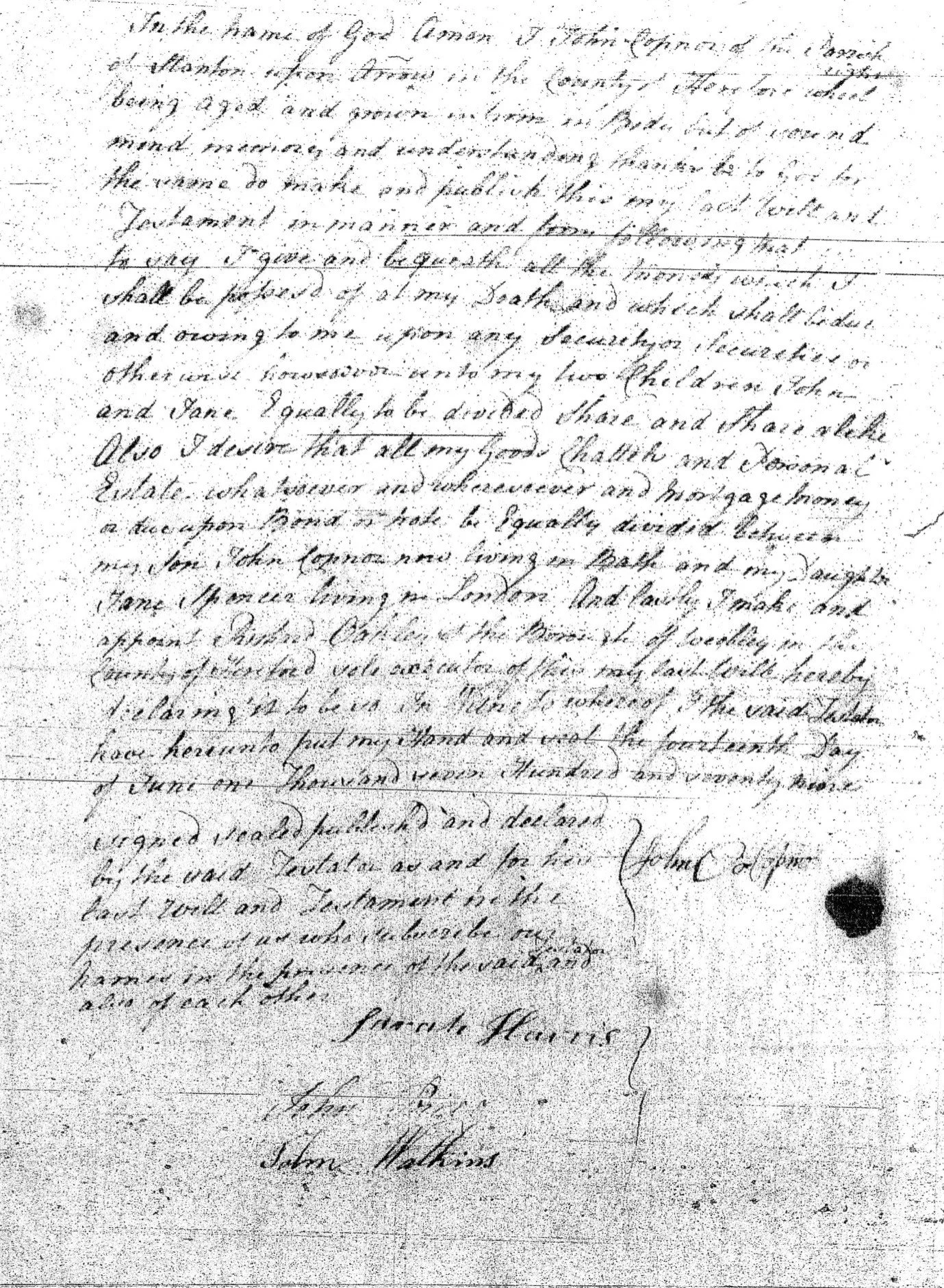
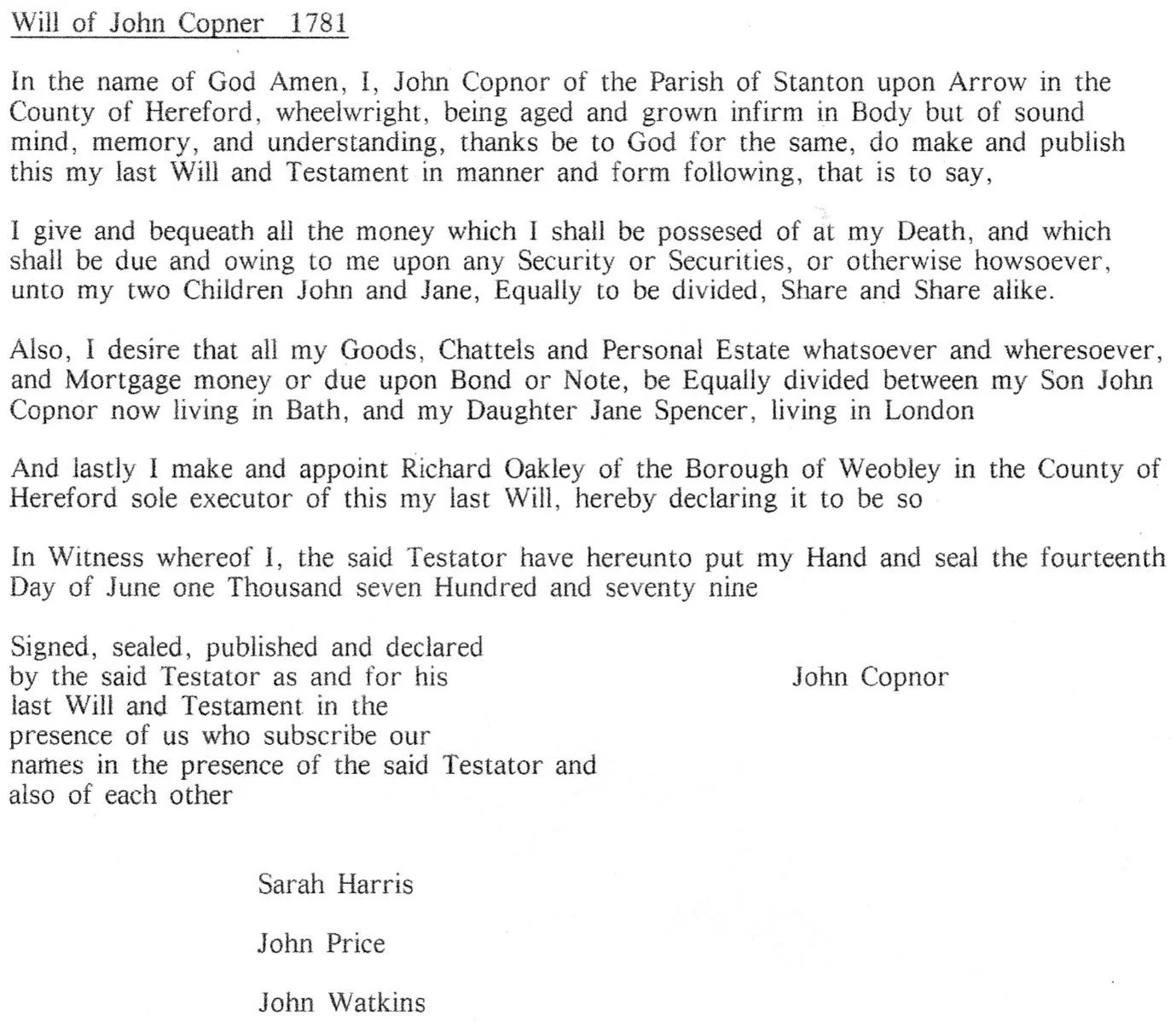
Interpretation
John’s will is even shorter than Joseph’s. It does not specify what goods and land he owns. This may mean that he owns relatively little, compared to his Marston relations, who are by now wealthy farmers owning several properties.
John is a wheelwright and has moved to Staunton on Arrow. As a younger son of a younger son his inheritance may have been relatively small as it was the tradition to leave the bulk of an estate to the eldest son.
He did inherit £6 13s 4d from his great uncle William who died childless.
John had a son John and a daughter Jane Spencer who lived in Bath and London respectively. This is the first time we find members of the family who have moved from the local area.
What is even more striking is that John leaves the whole of his estate to his children equally. This may signify that he didn’t have much to leave or that he was very enlightened for his time, treating his children equally and especially gifting half of his estate to his married daughter.
What was happening in the UK?
In 1771 Richard Arkwight invented a water driven mill which industrialised the spinning of cotton. His factory in Cromford, powered by the River Derwent, operated 24 hours a day and was able to produce cotton in vast quantities and at lower cost than the cottage industry of rural areas. This process was further enhanced by Samuel Compton in 1779. The wealth of Pembridge had been built on wool and cotton was now spelling the beginning of the end for the wool trade.
At Coalbrookdale the first iron bridge was constructed over the River Severn. The refining of iron founding by the Darby family would lead to metal replacing wood in the construction of ships, buildings, and railways, further industrialising many jobs at the expense of rural cottage industries.
What was happening in the world?
The astronomer, William Herschel, discovered Uranus which he initially called George’s Star in honour of George III.
The English conceded defeat in battle in the American War of Independence.
The French attempted to invade the Channel Islands but were defeated by the British
The Zong massacre saw 130 African slaves, on board the ship Zong, thrown overboard to claim insurance. This acted as a catalyst for the abolitionist movement.
Will of Henry Copner 1794 (Age 67 years)
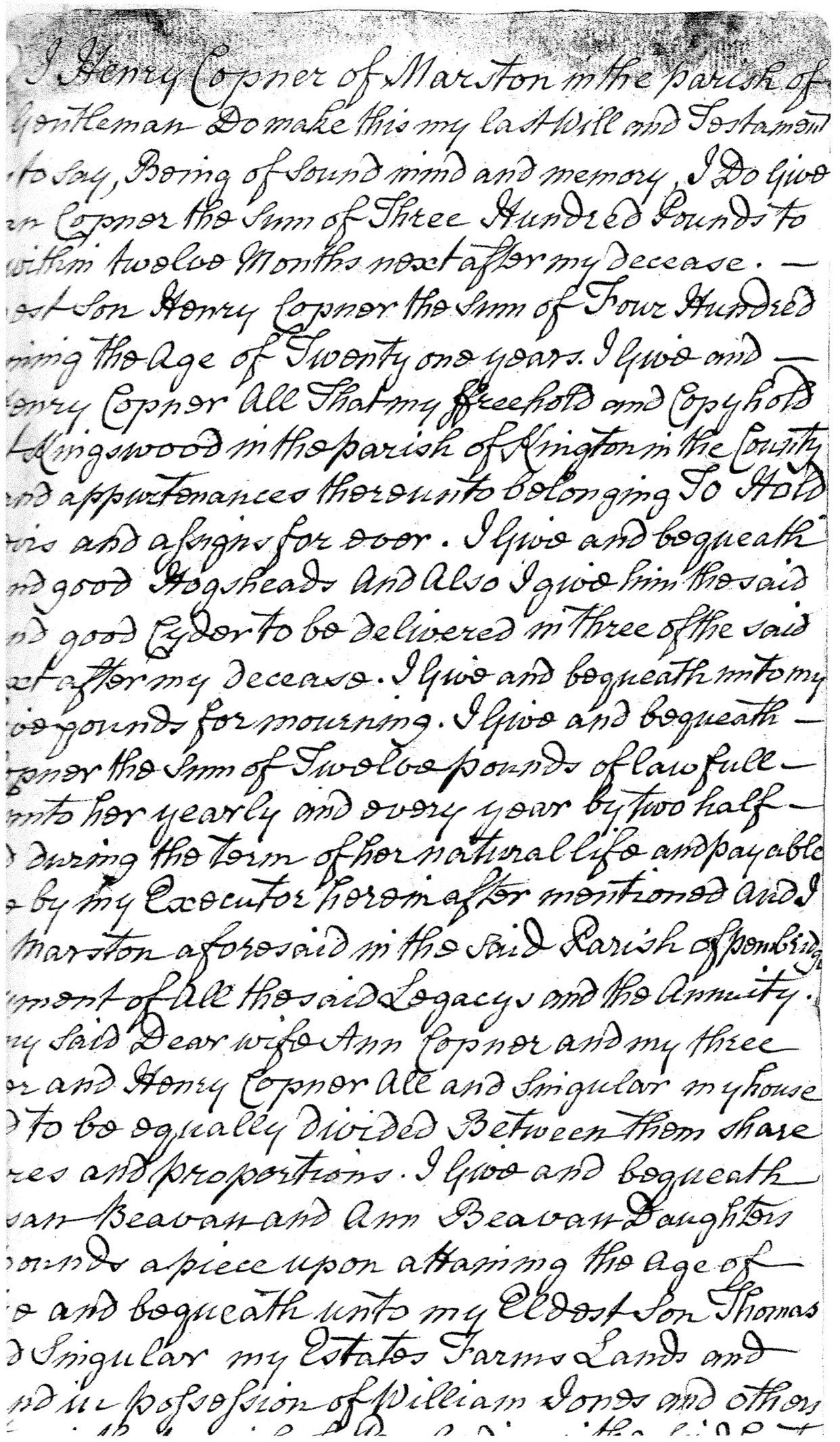
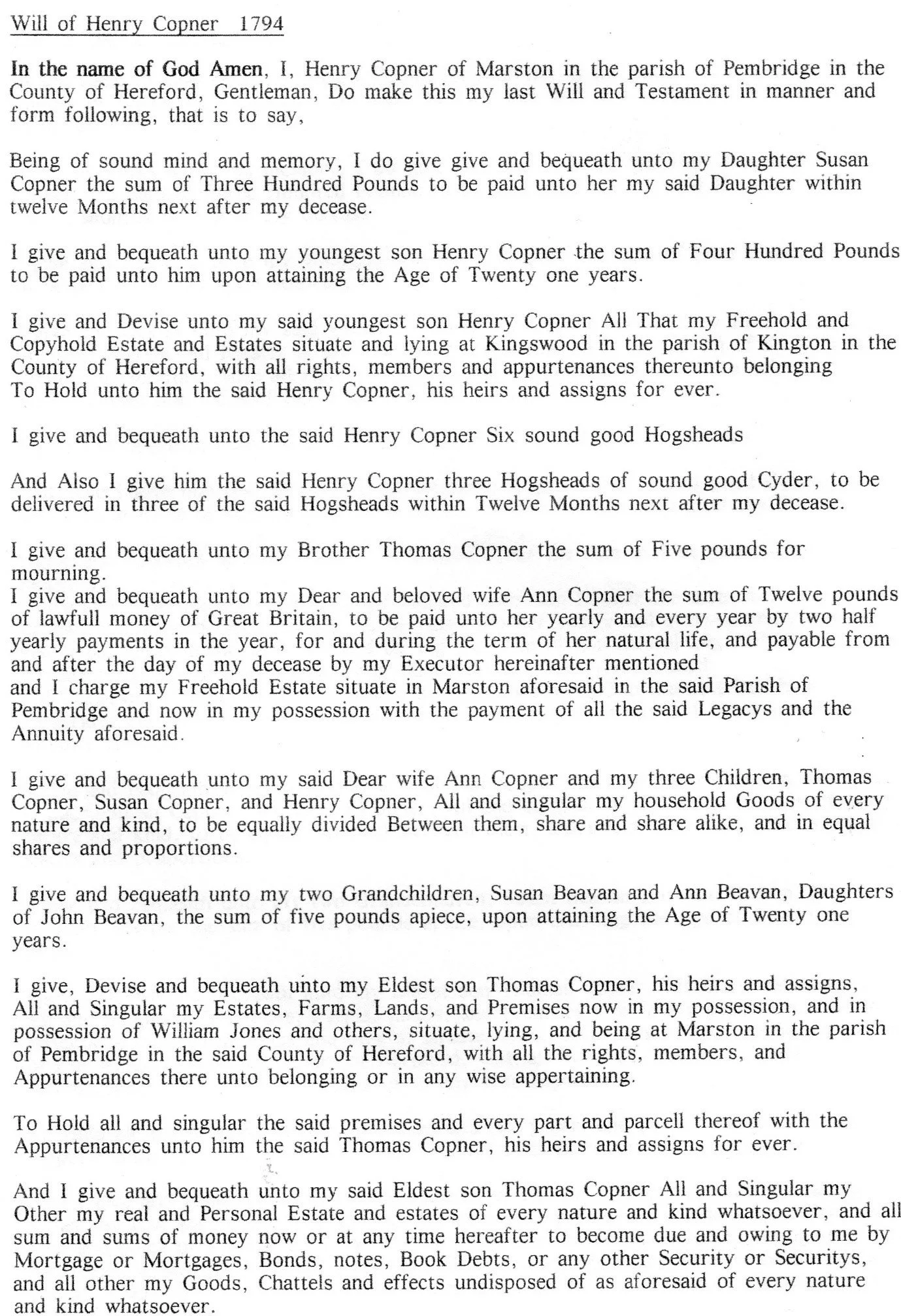
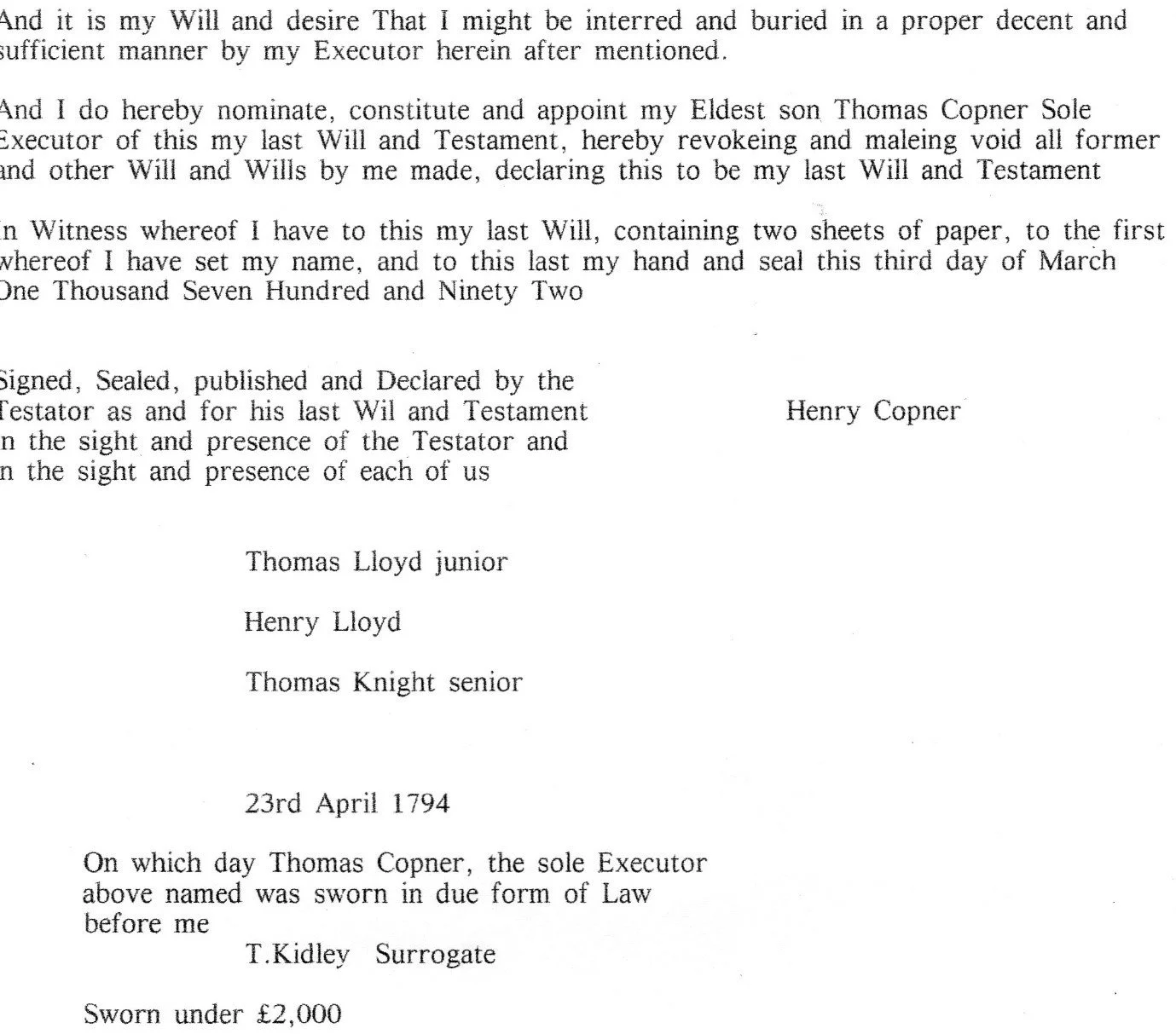
Interpretation
Henry’s daughter Susannah inherits £300 but her younger brother Henry, receives property in Kingswood as well as £400 in cash. This is another example of inheritance practice following the male heirs, as it is supposed that a daughter will marry and be looked after financially by a husband.
Henry also inherits six hogsheads ‘three of which contain’ sound good cyder. Cider was an important export from Herefordshire and sold in cities as far away as London and Bristol. Most farms would have a cider press that produced a regular supply for both property owners and workmen alike.
Henry’s wife Ann is left an annuity of £12 a year plus ‘share and share alike’ with the children of all the household items but the bulk of the estate, the ‘Estates, Farms, Lands and Premises’ in the hamlet as well as the residual capital, is inherited by his eldest son, Thomas. Presumably Ann could live in the farmhouse with her son and his family.
The description of the ‘Estates’ etc. suggest that there is more than one estate and farm, so we realise that the main farm business has become even more prosperous through the century. The Court Roll of 1784 tells us that Henry was liable for rent on three places.
Both Henry and his daughter Susannah were able to sign their names which presumes some standard of education.
The will itemises goods that represent a working farm and not a high degree of domestic comfort. Jewellery, books, pictures on the wall, rugs on the floors, these things are not mentioned either in previous wills or future wills of this family.
What was happening in the UK
Because of the fear of Revolution spreading from France there was increased suppression of political agitation.
William Blake was writing poetry. Artists Turner and Constable were at the beginning of their careers.
William Pitt the younger was Prime Minister.
The Industrial Revolution continued to change lives for most people. Steam engines were invented that were powered by coal burning, so mining became an important industry.
Food was in short supply in the UK, especially bread.
Higher taxes on wheat were imposed to pay for the French war, yet landowners generally remained prosperous.
Oats and barley were fetching high prices at this time and by the end of the 18th century 9000 tons of grain and meal were being sent every year from Herefordshire to Bristol, along the River Wye. 2000 tuns of cider was also being exported from the county.
What was happening in the World
The French Revolution was in full swing.
In America there was a rebellion about the tax levied on whisky. President George Washington had to use troops to suppress the uprising.
In Europe Romanticism was replacing Enlightenment in Arts and Literature .
The Classical Era was beginning in music. Haydn was in London at this time and Beethoven was 24 yrs old and writing his piano sonatas.
Will of Thomas Copner 1813 (Age 83 yrs)
Thomas, a bachelor, left the bulk of his estate in 1813 to his 9-year-old great nephew, also Thomas Copner, whose own father (another Thomas Copner) had died the year before.
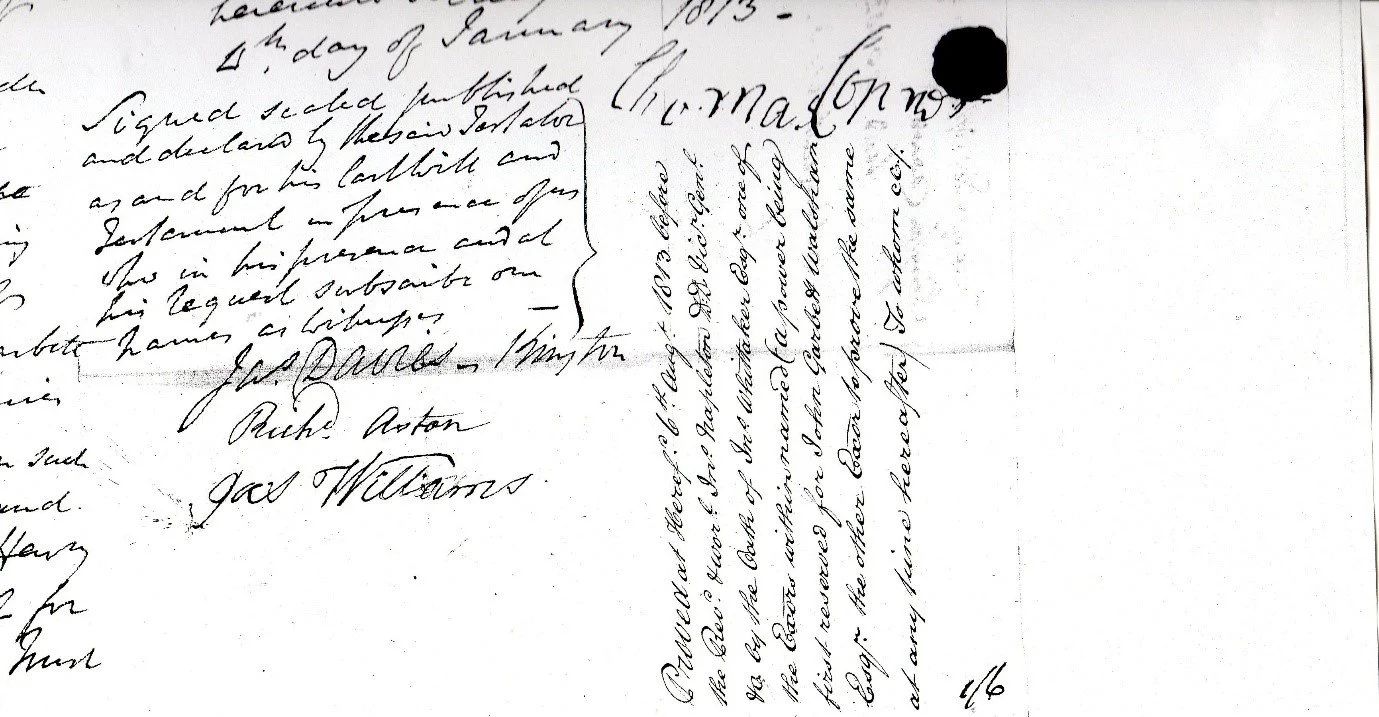
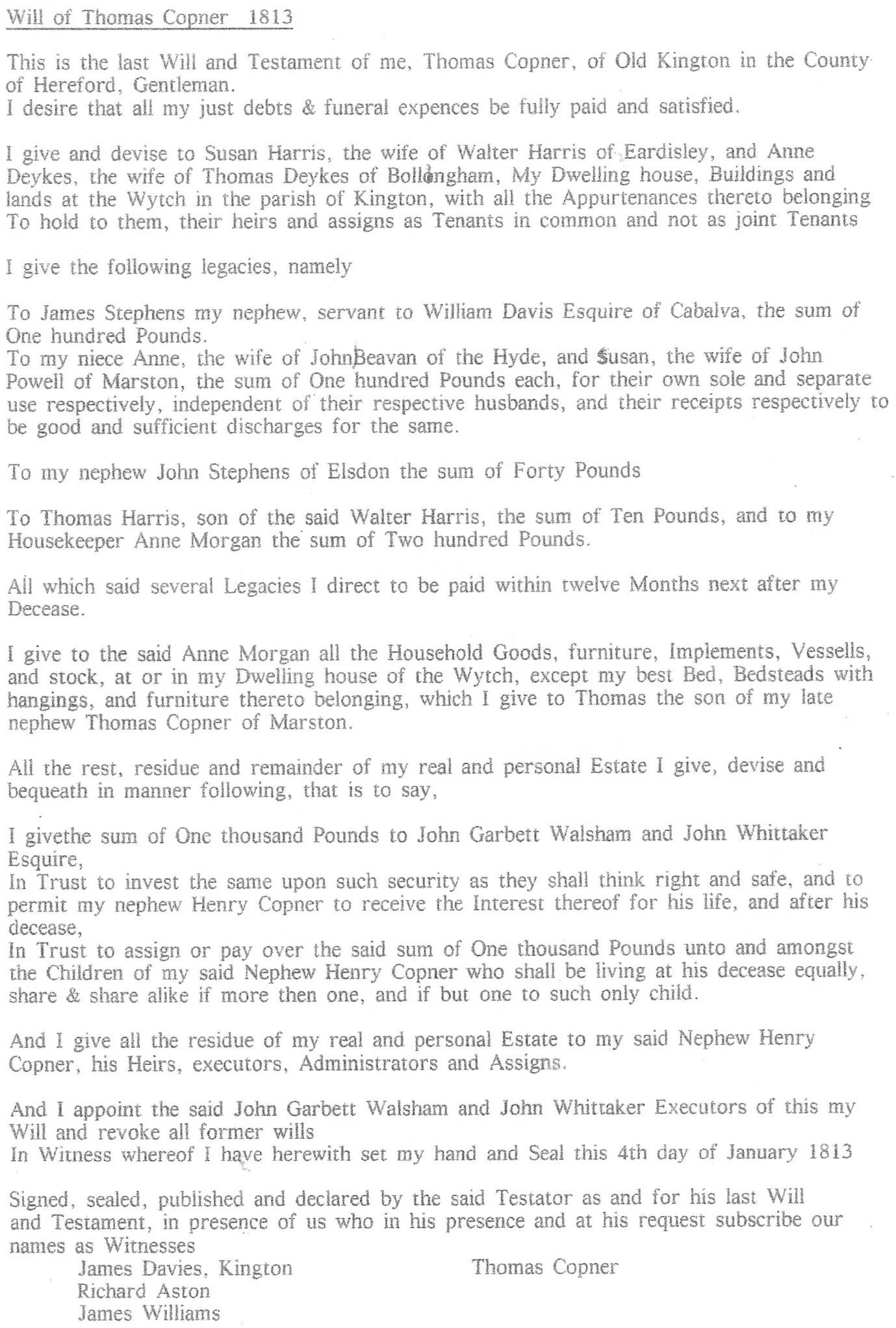
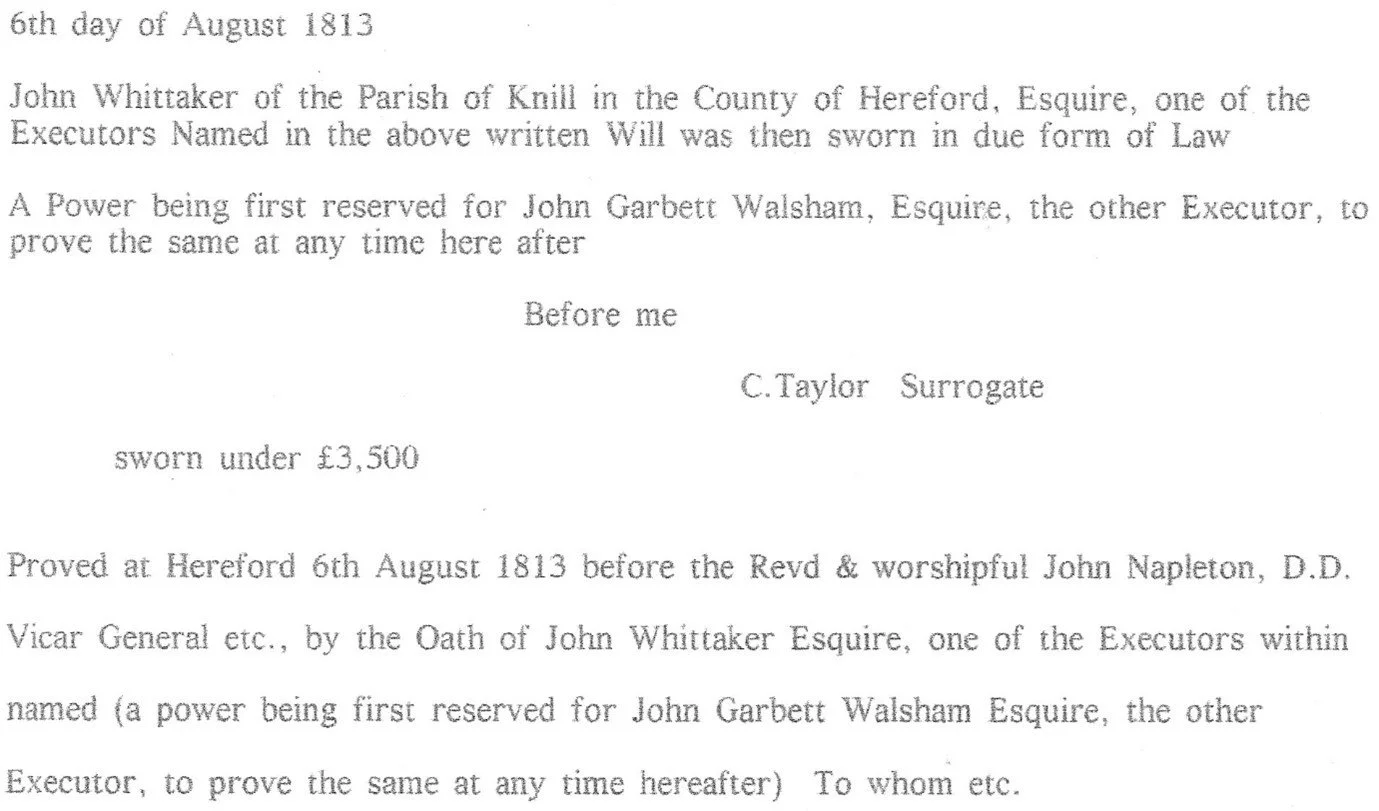
Thomas was the youngest son of Joseph Copner (1697-1767) and younger brother of Joseph who had died in 1794. Thomas was unmarried.
Thomas was probably living at the Wytch and leaves this ‘Dwelling house, Buildings and lands’ to the family of his older sister, Anne.
Thomas’s nephew, James receives £100 and is working as a servant in a house about two miles away at Cabal.
His two married nieces Anne and Susanna each receive £100 ‘independent of their respective husbands’ which again supports the financial independence of female relatives from their husbands.
Thomas’s housekeeper Anne Morgan is awarded £200 which was a substantial legacy at that time. It is noted that Thomas had reached a great age and being unmarried, he probably relied considerably on a good housekeeper, especially if she cooked for him. This housekeeper also receives the ‘Household Goods, furniture, implements, Vessells and stock’ at The Wytch.
Thomas’s nephew, also called Thomas, had died the previous year but he had a son, yet another Thomas, who was bequeathed the ‘best Bed, Bedsteads with hangings and furniture thereto belonging’ from the property at the Wytch.
This great nephew Thomas, who was 9 years old at the time, received an annuity from the interest gained from the legacy of £1000 and the ‘rest of the real and personal Estate’ (which presumably is the Wytch property) also goes to this great nephew.
What is happening at the time in the UK
Jane Austen published ‘Pride and Prejudice’.
David Livingstone was born.
James Watt, the engineer and inventor died.
The Napoleonic Wars were still being fought. Wellington defeated Bonaparte in the Peninsula War in Europe.
Sheep farming was declining in favour of raising cattle and growing cereals as this was more profitable. Because of the Napoleonic Wars, there were embargos on imports from Europe, so the UK had to be more self-sufficient.
George III was King but due to his failing health, his son the Prince Regent was effectively in control of the Royal household.
What is happening in the world
US troops defeated Britain in The Battle of the Thames.
The British East India Company was still flourishing.
The Vienna Conservatory was founded.
Beethoven was composing his 7th Symphony, Tchaikovsky had written the 1812 Overture
Thomas Copner 1857 (Age 53 years)
Thomas was the Great nephew of Thomas Copner senior.
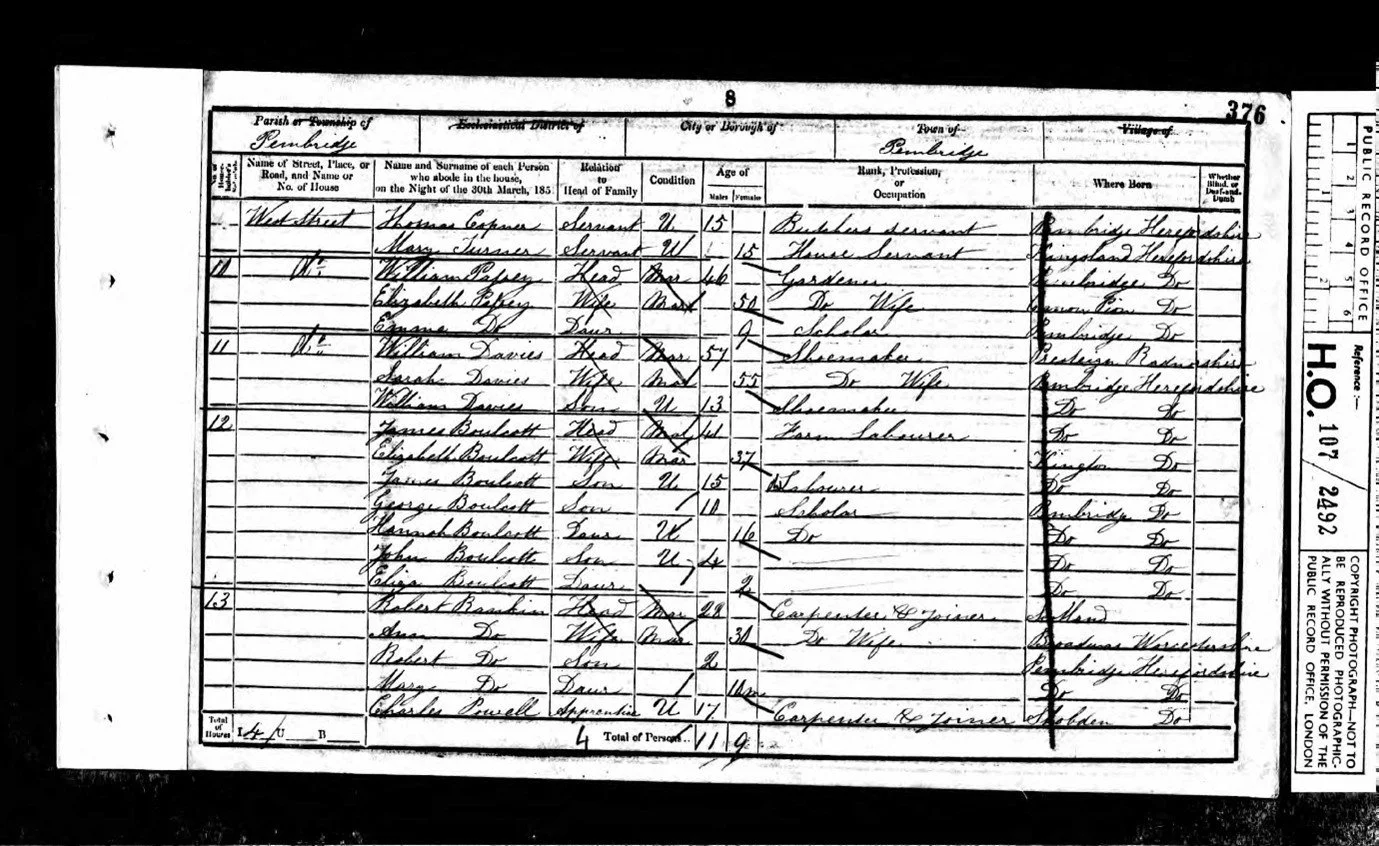
1841 Census extract
Thomas Copner (1804-1857) had inherited when still a child, a substantial legacy from his father Thomas Copner (1863-1812) and his Great Uncle Thomas Copner (1730-1813).
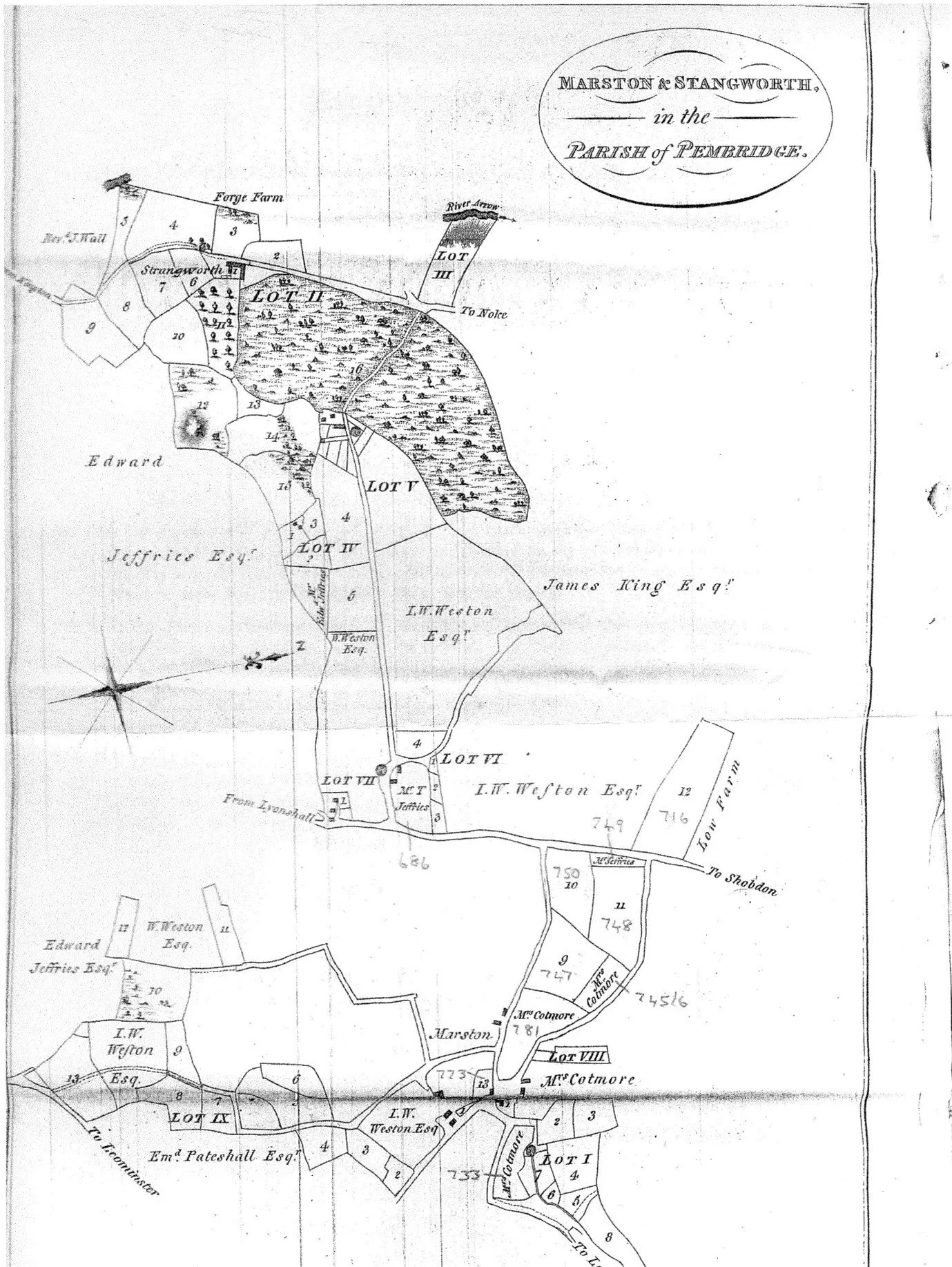
His mother Priscilla Copner (misspelt as Mrs Cotmore on the Estate Map below) held the property and lands at Marston from 1812 until Thomas became of age. Priscilla was aged 40 years old at this time and Thomas was 8 years old when his father died.
In 1824 Mrs Priscilla Copner now aged 52 years old ‘retires from the Farming Business’ and the farm is sold by auction. Thomas is 20 yrs old but does not take over the farm. Priscilla remarries in 1825.
The document below shows the farm in 1812 at the death of Mr Thomas Copner senior.
Piggot & Co’s Trade Directory for 1835 includes several members of the Copner family. Thomas Copner a Shoe and Bootmaker, Joseph Copner a Malster and Henry Copner a member of the Gentry. Exactly which members of the family these are is unclear due to the same first names being repeated throughout the family.
At the time of the 1841 Census, Thomas (40 years old) was living with his wife Charlotte, two servants and his nephew Thomas Watkins in a cottage next to the family farmhouse which was being rented out.
At the end of the 1840s there was widespread economic and financial crisis in rural parts of Herefordshire, and it was possible that the farm was left empty during this time.
The Lord of the Manor changed from the Earl of Oxford to Lyndon Evelyn Esquire. There are two surviving rentals that show Thomas was still living in the same hamlet, next to the family farm in 1851.
Thomas died in 1857 in Oxford.
What was happening in the UK
Queen Victoria was on the throne and Palmerston was Prime Minister
This was the age of ‘Railway Mania’ and the first train from Leominster to Kington ran in July 1857, stopping at Pembridge station which had been completed the year before.
Prince Albert sought to create a cultural haven in South Kensington and founded the Victoria and Albert Museum
Industrialisation was at its peak with Manchester alone home to 2,500 mills employing 500,000 workers.
Edward Elgarthe composer and Robert Baden Powell founder of the Scouts were born.
In farming the first steam powered plough was invented and steam powered threshing machines were becoming more common.
What was happening in the world
The Indian Mutiny shook Britain as protests against the dominance of the East India Company spread throughout the sub-continent.
The Second Opium War was fought by France and Great Britain against the Chinese.
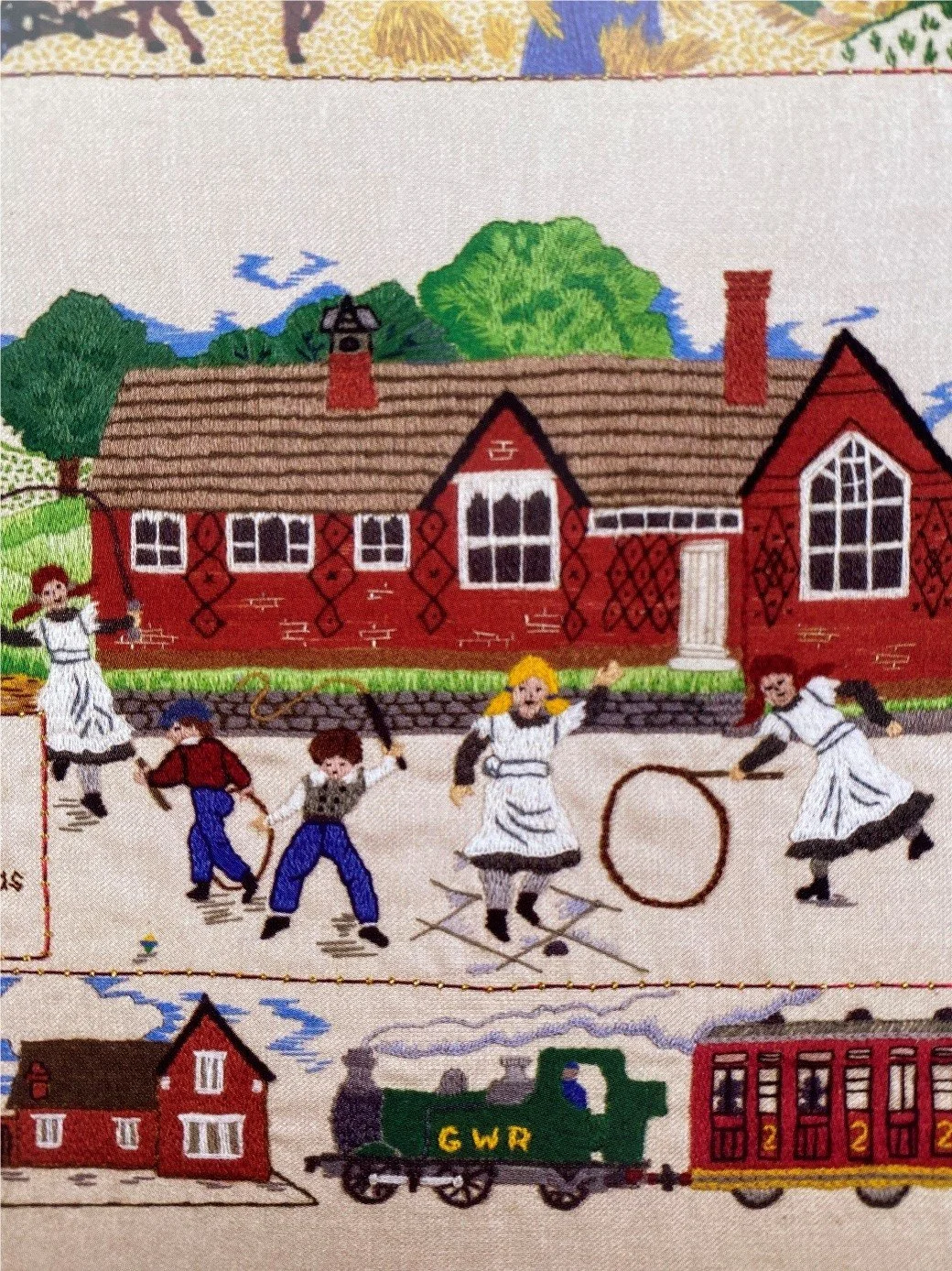
Detail from the Pembridge Tapestries showing the mid-Victorian Pembridge station and Village Primary School. The tapestries are displayed in St Mary’s Church Pembridge.
